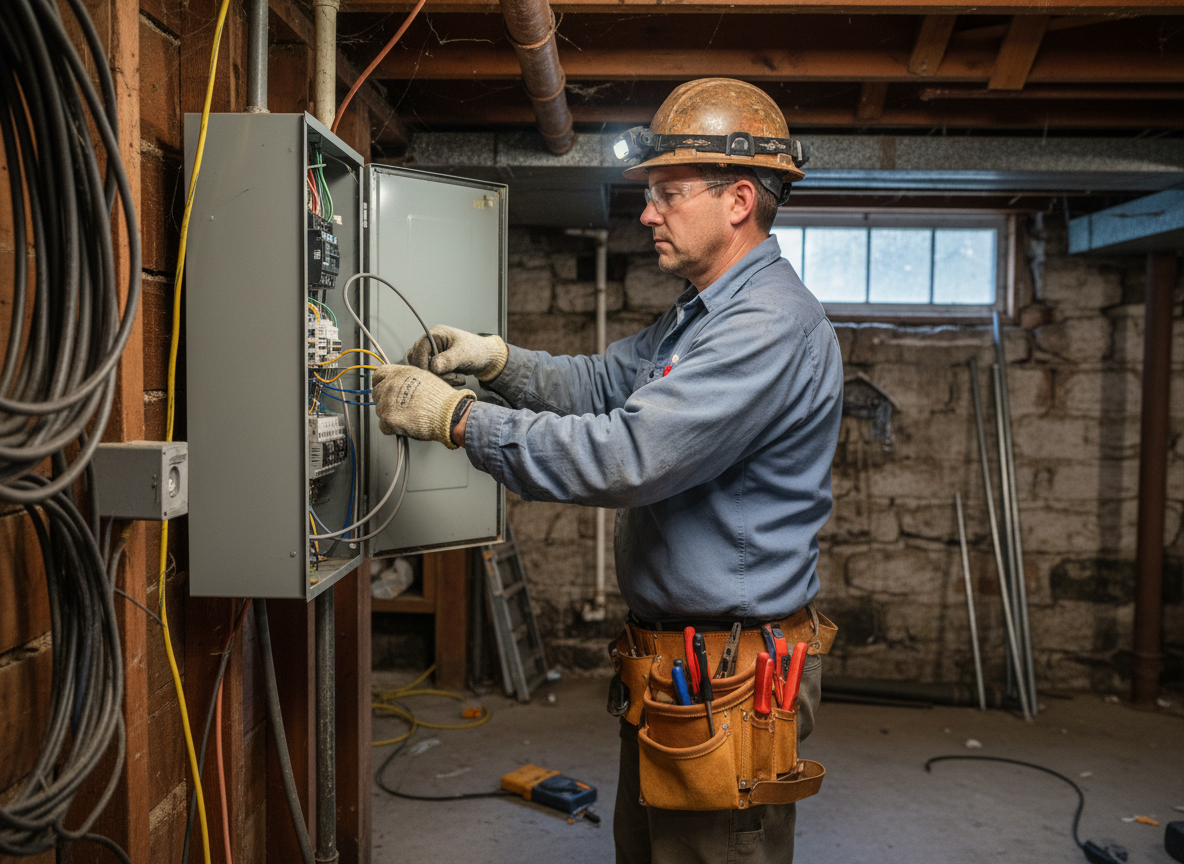
A residential electrician diagnoses and repairs the electrical system in your house: the service panel, branch circuits, outlets, switches, lighting and the wiring that connects them. Electrician Portland Oregon is a licensed, owner operated electrical contractor serving Portland, Oregon, run by a master electrician since 2011. Diagnosis starts at the panel, not at the symptom. A dead outlet, a warm switch plate or a breaker that trips are read against the panel label, then traced with a voltage tester and circuit tracer to find the actual fault, which is often two or three junction boxes away from where the problem shows up.
Portland housing makes this work different from newer cities. Much of the inner east side and north side was built between 1900 and 1940, so we regularly open walls and find knob and tube, cloth insulated conductors and ungrounded two prong outlets fed from 60 to 100 amp services. Mid century neighborhoods add aluminum branch wiring and backstabbed devices. Panels here usually sit in basements, garages and unfinished utility rooms, and the October through May wet season pushes moisture into those spaces, corroding neutral bars and junction boxes in crawlspaces. Heat pumps added after the 2021 heat dome and Level 2 EV chargers are now landing on panels that were never sized for them.
Most residential electrical work in Portland requires a permit from Portland Permitting and Development, and all of it must meet the Oregon Electrical Specialty Code, which is the NEC as amended by the state. New circuits, panel work and wiring alterations get a permit; work concealed in walls gets a rough in inspection before drywall and a final inspection when done. Bedroom and living area circuits need AFCI protection, and kitchens, bathrooms, garages, basements and exterior outlets need GFCI protection when circuits are extended or replaced. We pull the permit under our license, meet the inspector and close it out, so the record follows the house at resale.
Field experience matters on service calls. Half the flickering light complaints we chase in older Portland homes trace to a loose neutral, sometimes at the utility connection rather than inside the house, and PGE or Pacific Power has to fix their side. Breakers that trip only during winter storms often point to moisture in an exterior box, not an overload. We also find double tapped breakers and tandem breakers stuffed into panels not listed for them, which passes casual inspection but overloads the busbar. Backstab connections behind 1970s outlets loosen with age and cause intermittent faults that a plug-in tester will not catch until the device is pulled.
Technician insight
The fault in an older Portland house is rarely where the symptom shows up: flickering lights usually trace to a loose neutral 2 or 3 junction boxes away, or on the utility side of the meter. The other regular surprise is a breaker that only trips during winter storms, which points to moisture in an exterior box rather than an overload.
Tracing a Dead Circuit in a Pre War Alberta House
A homeowner in the Alberta neighborhood called about a bedroom where half the outlets had gone dead, with no tripped breaker at the panel. The house was built in the 1920s, and the panel label was a mix of guesses from previous owners, so we started with a grounding and bonding check and traced the circuit with a voltage tester and circuit tracer. The fault turned out to be a failed backstab connection in a hallway outlet 2 rooms away, where a device swapped in the 1970s had loosened with age. While the device was open we found cloth insulated conductors feeding the run and documented them for the owner. We repaired the connection with proper screw terminals, replaced 2 more backstabbed devices on the same circuit, and updated the panel directory so the next person does not start from zero. The whole visit landed in the normal diagnostic range, and the owner now has a written record of where the old wiring runs.
Residential Electrician Services We Offer
✓Electrical Troubleshooting and Repair
Finding and fixing dead circuits, tripping breakers, flickering lights and intermittent faults, with the cause documented before anything is replaced.
✓Outlet and Switch Replacement
Swapping worn, ungrounded or backstabbed devices, adding tamper resistant outlets and correcting reversed polarity and open grounds.
✓GFCI and AFCI Protection
Adding required protection in kitchens, bathrooms, basements, garages and bedrooms, at the device or at the breaker.
✓Lighting Installation
Recessed cans, fixture swaps, undercabinet lighting and dimmer circuits, including boxes rated for fan or fixture weight.
✓Ceiling Fan Installation
Fan rated box installation and switching, including retrofits in plaster ceilings common in pre war Portland homes.
✓Circuit Additions
New dedicated circuits for appliances, shops, ranges, dryers and home offices, sized with a load calculation.
✓Whole Home Surge Protection
Panel mounted surge protective devices that clamp spikes from storms and utility switching before they reach electronics.
✓Smoke and CO Detector Wiring
Hardwired, interconnected detectors installed to current placement rules during remodels and rewires.
How it works
- 1
Assessment
We inspect the panel, test the affected circuits and check grounding and bonding, then explain what we found in plain language before quoting anything.
- 2
Scope And Quote
You get a written scope with a firm price for defined work, including whether a permit and inspections apply.
- 3
The Work
We protect floors, keep circuits labeled as we go, and schedule the rough in inspection with Portland Permitting and Development if walls are open.
- 4
Final Inspection And Walkthrough
We meet the inspector for final, update your panel directory, and walk you through everything that changed.
Pricing
Residential service calls in Portland usually start in the $150 to $350 range for diagnosis and minor repairs, with device replacements often in the $150 to $300 range per location and new dedicated circuits commonly running $400 to $1,500 depending on distance from the panel and how the cable has to be routed. Prices rise when the run crosses a tight crawlspace, when plaster and lath walls limit fishing, when knob and tube or aluminum wiring is found on the circuit, and when the panel has no open spaces so a circuit addition becomes a panel conversation. Permit fees are separate and passed through. Every job gets a written price before work begins, never a guess over the phone.