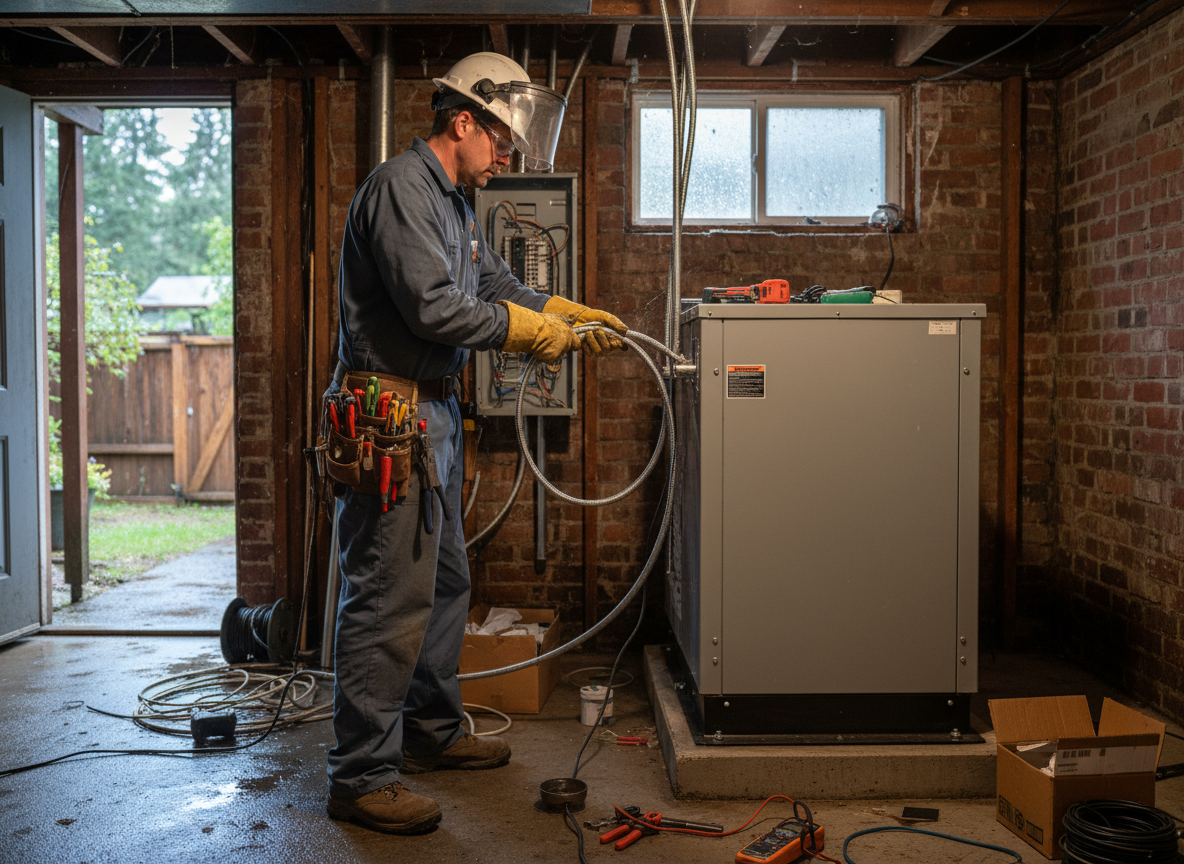
Generator installation means wiring a backup power source into your service panel safely, through either an automatic transfer switch for a standby unit or an interlock kit and inlet for a portable generator, so your furnace, refrigerator, well pump, or the whole house keeps running when the utility goes down. Electrician Portland Oregon, a licensed, owner operated electrical contractor serving Portland, Oregon, starts every generator job with a load calculation. We list the circuits you actually need during an outage, add up running and starting watts, and size the generator and transfer equipment to match. That step is where most DIY setups go wrong: an undersized generator that stalls when the furnace blower and refrigerator compressor start at the same moment.
Portland's outage pattern drives the design. Winter windstorms and ice storms from roughly November through February drop limbs on lines, tear service drops, and snap service masts, and the 2021 ice storm left parts of the metro dark for most of a week. Multi day outages are the planning case here, not 2 hour blips. That argues for fuel you can sustain: natural gas standby units run indefinitely, while a portable on gasoline needs refueling every 8 to 12 hours. The October through May wet season also matters for placement. Outdoor inlets, transfer switches, and standby units need weatherproof enclosures, drip loops, and in-use covers, because a corroded inlet contact is a common failure we find on systems installed by handymen.
Every generator interconnection in Portland requires an electrical permit from Portland Permitting and Development and must meet the Oregon Electrical Specialty Code. The inspector will check that backfeed is impossible: a listed transfer switch or a panel-listed interlock kit, never a suicide cord or a breaker held in place by hope. Standby units also need mechanical and sometimes gas piping permits, clearances from windows and gas meters, and a concrete or composite pad. Cascadia seismic risk means we anchor standby units and strap the fuel connection so the flexible gas line survives ground movement. Whole house transfer switches trigger a review of your service equipment, and many older Portland homes on 60 to 100 amp services need a service upgrade first.
The edge cases are where experience pays. Federal Pacific Stab-Lok and Zinsco panels, common in Portland's mid century neighborhoods, should not take an interlock kit; the breakers cannot be trusted to hold, and we recommend a panel replacement before interconnection. Homes served by Pacific Power in southwest Portland sometimes sit on long rural style secondary runs where voltage drop already runs high, and a generator with a floating neutral will trip GFCI breakers unless bonding is handled correctly at the transfer switch. Well pumps and heat pumps need their starting current checked, not just running watts. And a portable generator must sit at least 20 feet from openings with the exhaust pointed away, which on a tight inner east side lot takes real planning.
Technician insight
The panel is what trips people up on generator work in Portland: our mid century neighborhoods are full of Federal Pacific Stab-Lok and Zinsco panels that should never take an interlock kit, and a portable unit with a floating neutral will keep tripping GFCI breakers until bonding is handled correctly at the transfer switch.
An Interlock That Had to Wait for a Panel
A homeowner in Montavilla called after the last ice storm wanting an interlock kit for the portable generator already sitting in the garage. The load calculation was fine, with the furnace blower, refrigerator, freezer, and lights well within the unit's running watts. The panel was not: a Federal Pacific Stab-Lok, so no listed interlock existed and the breakers could not be trusted to hold. We replaced the panel first, then installed the interlock, a back fed breaker, and an outdoor inlet box with an in-use cover on the driveway side of the house. The inlet placement kept the generator the required 20 feet from windows and doors, which took some measuring on a narrow east side lot. After inspection we ran a live transfer test under load and walked the owner through the cord and breaker sequence.
Generator Installation Services We Offer
✓Standby Generator Installation
Full installation of an automatic natural gas or propane standby generator, including pad, gas coordination, transfer switch, and startup testing.
✓Automatic Transfer Switch Installation
Wiring a service rated or load side automatic transfer switch so a standby generator picks up the house without anyone touching a breaker.
✓Manual Transfer Switch Installation
A 6 to 10 circuit manual transfer switch beside your panel so a portable generator can safely run selected circuits.
✓Generator Interlock Kit Installation
A panel-listed interlock and back fed breaker that lets a portable generator power your existing panel for far less than a transfer switch.
✓Portable Generator Inlet Installation
An outdoor power inlet box with weatherproof cover and dedicated cable path so you plug the generator in outside, not through a window.
✓Generator Load Management Setup
Load shedding modules for heat pumps, water heaters, and EV chargers so a smaller generator can serve a larger panel without overloading.
✓Generator Sizing and Load Calculation
A written load calculation of running and starting watts for the circuits you need, so you buy the right size unit once.
✓Generator Repair and Maintenance Wiring
Troubleshooting transfer switches that fail to exercise, corroded inlets, and control wiring faults on existing systems.
How it works
- 1
Load calculation and site visit
We walk the house, list outage-critical circuits, measure starting loads on motors, and check panel condition, service size, and where the unit or inlet can legally sit.
- 2
Design and permit
We spec the generator, transfer equipment, and any panel work, then pull the electrical permit through Portland Permitting and Development before wire goes in.
- 3
Installation
We set the pad and unit or mount the inlet, install the transfer switch or interlock, run conductors in conduit, and bond and label everything per the Oregon Electrical Specialty Code.
- 4
Inspection and live test
The city inspector signs off, then we simulate an outage, verify transfer under load, confirm no backfeed, and walk you through operation and exercise cycles.
Pricing
The transfer method moves the price more than anything else. An interlock kit with an inlet and back fed breaker is the low end, commonly in the $800 to $2,000 range installed. A manual transfer switch with a portable inlet typically lands between $1,500 and $3,500. A full standby generator with automatic transfer switch, pad, and gas coordination usually runs $9,000 to $18,000 or more depending on unit size and gas line length. Panel condition is the wildcard: a Zinsco or Federal Pacific panel, or a 60 amp service, adds a panel or service upgrade before interconnection. Long conduit runs, finished basements, and load management modules add labor. These are ranges, not quotes; the load calculation sets the real number.