2026-08-31 · Trevor Lindquist
Wiring an ADU in Portland: Subpanels, Feeders and Detached Structure Rules
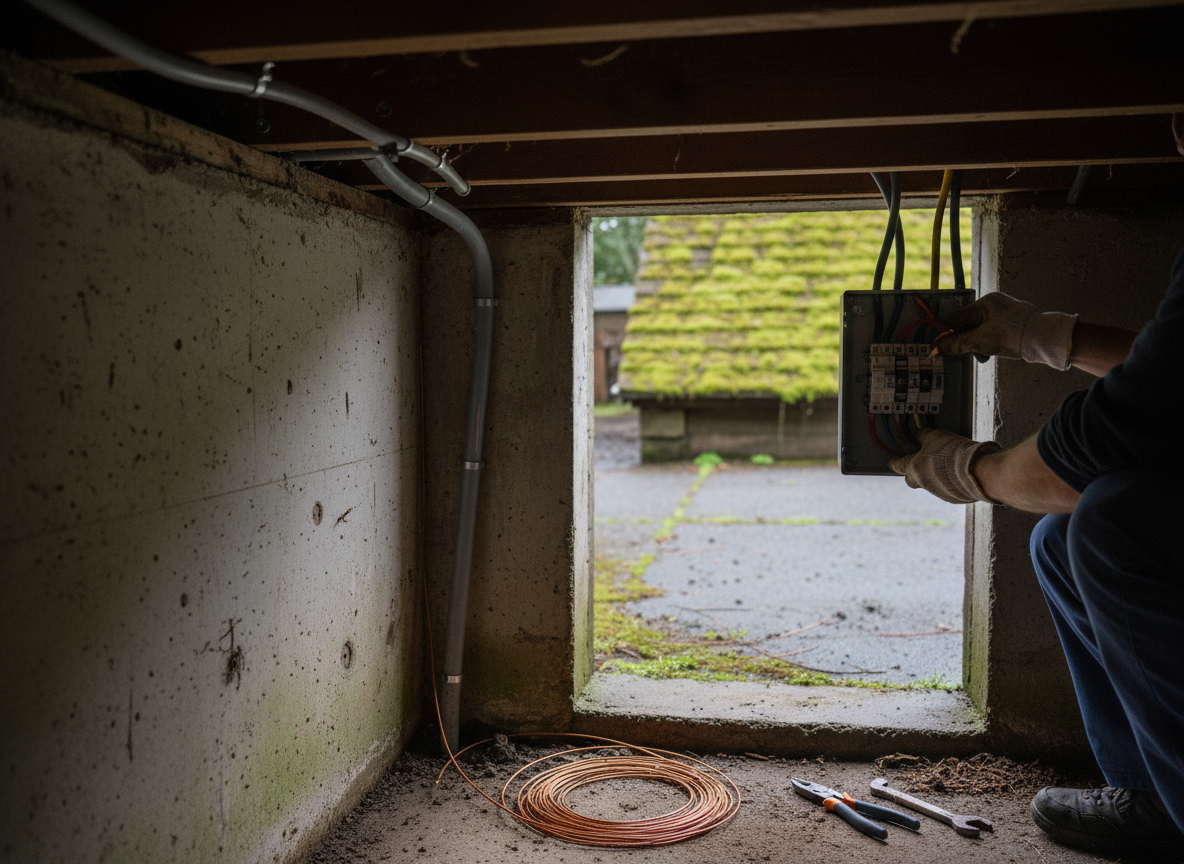
Wiring a detached ADU requires 4 core pieces: a feeder sized by a load calculation for the unit, a subpanel with separated neutrals and grounds, a disconnecting means at or in the ADU, and a grounding electrode system at the detached building itself. Most projects also trigger a look at whether the main house service can carry the added load.
Why a Detached Building Is Its Own Electrical World
The reason the rules stack up is simple physics and fault behavior. When you run power to a separate structure, you are extending your electrical system across open ground. If lightning, a utility surge, or a fault raises the voltage on that run, the detached building needs its own connection to earth to stabilize it. That is why the Oregon Electrical Specialty Code requires a grounding electrode at the ADU, usually 2 ground rods driven 6 feet apart, connected to the subpanel with a grounding electrode conductor.
The second principle is neutral separation. In your main service panel, neutral and ground are bonded together in 1 place. Everywhere downstream, including every subpanel, they must be kept apart: insulated neutral bar for the white wires, separate ground bar for the bare and green ones, bonding screw removed. If they are tied together in the ADU panel, normal return current flows on the ground wire and on anything metal bonded to it. That includes water lines and gas piping between the buildings. It works fine right up until the day a connection fails and every grounded surface in the ADU sits at line voltage. This is the single most common defect we find in ADU panels wired by general contractors or homeowners, and it is an automatic inspection failure.
Third, the disconnect. Someone working on the ADU, or a firefighter standing in front of it, must be able to kill power to the whole structure without walking to the main house. The code requires a disconnecting means at the detached building, either a main breaker in the subpanel or a separate disconnect outside.
Sizing the Feeder: Where the Real Money Is
The feeder is the buried or overhead run from the main panel to the ADU, and it is sized by a load calculation for the unit, not by guesswork. A typical 1 bedroom detached ADU with electric heat, an electric water heater, a range, and laundry usually calculates out to a 90 to 125 amp feeder. If the ADU gets a heat pump and an EV charger, which is a common Portland combination now, the number climbs.
Local factors that decide how hard the job is:
- Capacity at the main house. Many inner east side and north Portland houses feeding new backyard ADUs still have 100 amp services, some with fuse panels or cloth wiring upstream. A large share of ADU projects begin with a 200 amp service upgrade at the main house, and it is far cheaper to discover that during design than after the foundation is poured.
- Trench routing. Direct burial feeder or conduit needs 18 to 24 inches of cover depending on the wiring method. Portland lots complicate this with mature tree roots, old sewer laterals, and abandoned oil tanks on properties built before 1940. We plan the trench line before anyone digs, and utility locates are mandatory.
- Voltage drop. A 100 foot plus run to a back corner of a deep lot may need conductors upsized a gauge beyond what ampacity alone requires, so the ADU does not see dimming lights every time the water heater kicks on.
- Separate meter or shared. Most ADUs share the house meter. A separate service through Portland General Electric or Pacific Power is possible but adds cost and utility coordination, and it changes the grounding and disconnect layout entirely.
How to Check an Existing ADU or a Plan on Paper
If you are buying a property with an ADU or reviewing a builder's plan, look for these:
- Open the ADU subpanel cover, or have an electrician do it, and confirm neutrals and grounds land on separate bars with no green bonding screw installed.
- Look for the grounding electrode conductor leaving the panel toward driven rods near the foundation. No visible connection to earth at the building is a red flag.
- Confirm a main disconnect at the ADU, not just breakers.
- Ask for the permit record. Detached ADU wiring in the city requires permits and both rough in and final inspections through Portland Permitting and Development. An ADU with no electrical permit history was likely wired informally, and lenders and insurers increasingly ask.
- Check the feeder breaker in the main panel matches the feeder conductor size. A 60 amp breaker feeding a panel labeled 125 amps is legal but tells you the unit has less capacity than its panel suggests.
What to Do About Problems and When They Turn Dangerous
Missing ground rods and a bonded neutral in a subpanel are usually correctable in a day without rewiring: drive the electrodes, separate the bars, verify the feeder has 4 conductors. The expensive problem is a 3 wire feeder with no equipment ground, common in older detached garage conversions. That configuration cannot be fixed at the panel. It needs a new 4 wire feeder, which means opening the trench or conduit run.
It becomes a safety issue the moment the neutral path is compromised. With grounds and neutrals improperly combined, a corroded splice or loose lug, which our wet season from roughly October through May actively encourages in underground junction boxes and exterior connections, can energize the ADU's metal fixtures, appliance frames, and hose bibs. Tingling from a faucet or light switch in a detached structure is a report we take seriously and treat as an emergency call.
Electrician Portland Oregon is a licensed and insured, owner operated contractor that handles ADU feeders, subpanels, and the service and panel upgrades that often come first, and we are happy to review your plans before the trench gets dug.
Frequently Asked Questions
Does a detached ADU need its own ground rods?
Yes, a detached ADU with a subpanel must have its own grounding electrode system, typically 2 ground rods driven near the building and bonded to the subpanel. The equipment ground carried in the feeder is still required as the fault clearing path, so the rods are in addition to a 4 wire feeder, not a substitute for one. Inspectors in Portland check for both at rough in and final.
Can I feed an ADU from my existing 100 amp panel?
Sometimes, but only if a load calculation covering both the house and the ADU shows the 100 amp service can carry the combined demand. A small studio ADU with gas or minimal electric loads may fit. A 1 bedroom unit with electric heat, water heating, and cooking usually does not, and the project starts with a 200 amp service upgrade at the main house. Running the numbers first prevents an expensive surprise mid build.
Why do neutrals and grounds have to be separated in an ADU subpanel?
Because neutral and ground may be bonded only once, at the main service, and combining them again downstream puts normal current on the ground wires and everything bonded to them. In a detached building that can include water piping and appliance frames. If the neutral connection then corrodes or loosens, those surfaces can become energized. Separated bars keep the ground path clean so it only carries current during a fault, when it trips the breaker.