2026-08-31 · Trevor Lindquist
Portland General Electric Service Drop and Weatherhead: Which Parts Are Yours and Which Belong to the Utility
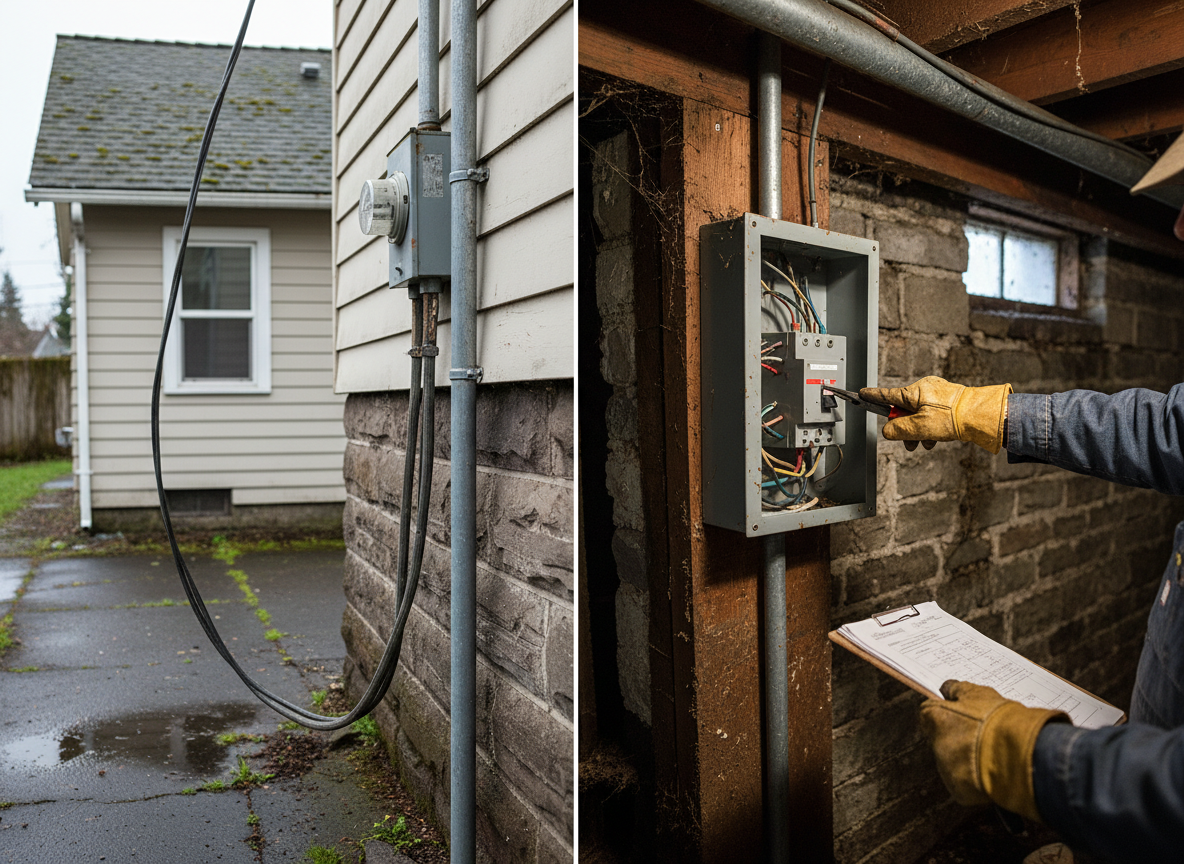
Portland General Electric owns the overhead service drop, the splices where it connects at your roofline, and the meter itself. You own the weatherhead, the service mast, the service entrance conductors running down to the meter, the meter base, and everything downstream of it. That split decides who pays when something breaks.
Why the Ownership Line Sits Where It Does
The utility's responsibility ends at the point of connection. PGE runs its wires from the pole or transformer to your house, and those wires terminate at splices just past the weatherhead. Everything the utility can maintain from the pole side, it owns. Everything attached to your structure is considered part of the building, and the building is yours.
The meter is the one exception on your side of the line. The glass-domed meter plugs into the meter base, and while the base belongs to you, the meter inside it belongs to PGE. Never pull a meter yourself. Breaking the seal without authorization gets you a call from the utility, and the exposed jaws behind it carry the full unfused capacity of the service.
Here is the full inventory, from the pole inward:
- Service drop: the overhead cable from pole to house. Utility owned.
- Splices at the weatherhead: the crimped connections where the drop meets your conductors. Utility owned.
- Weatherhead: the hooded fitting that keeps rain out of the mast. Yours.
- Service mast: the rigid conduit rising through or alongside the roof. Yours.
- Service entrance conductors: the wires inside the mast. Yours.
- Meter base: the enclosure the meter plugs into. Yours.
- Meter: utility owned, even though it sits in your enclosure.
- Main panel, main breaker, grounding, everything downstream: yours.
Homes in west and southwest Portland served by Pacific Power follow essentially the same split, so the logic holds regardless of which utility feeds you.
How the Mechanism Fails in Practice
The weak points are mechanical, not electrical. The service drop hangs its full weight, plus wind load and ice load, on the mast and its attachment hardware. A drop that has sagged over the years, or one loaded by a limb during a windstorm, pulls the mast out of plumb, bends it at the roofline, or rips the attachment bracket off the fascia entirely.
Water is the other mechanism. The weatherhead is angled downward so the drip loop in the conductors sheds rain before it can follow the wires into the mast. When the weatherhead cracks, or the mast flashing at the roof penetration fails, water tracks down the service entrance conductors into the meter base and sometimes all the way into the main panel. During Portland's wet season, roughly October through May, we open meter bases and find green corrosion on the lugs and rust streaks below the conductor entries. That corrosion raises resistance at the connection, which creates heat, which accelerates the failure.
How to Tell Whose Problem You Have
Stand back and look at the run from pole to panel. Signs that point to a utility problem: a drop sagging low over the driveway, frayed or bird-damaged cable out over the yard, or a splice at the weatherhead that is blackened or arcing. Call PGE for those, and they will usually repair their side at no charge.
Signs that point to your equipment: a mast leaning or bent, a weatherhead tilted or missing its cap, rust or water staining on the meter base, a drip loop pulled tight with no slack, or flickering lights across the whole house when the wind blows. Whole-house flickering in wind is a classic symptom of a loose connection at the weatherhead splices or at the meter base lugs, and diagnosing which side of the line it sits on takes a coordinated look, often with the utility pulling the meter so a licensed electrician can inspect the base.
One field note worth knowing: after a storm tears a drop, PGE will not reconnect to a damaged mast. If your mast is bent or the attachment point is torn out, the utility repairs its drop but leaves you disconnected until a permitted repair of the mast is complete and Portland Permitting and Development has released it. That sequencing surprises homeowners every winter, and it is why mast repairs get treated as emergency work during outage events.
What to Do About It and When It Becomes a Safety Issue
If any wire is down or the mast has pulled away from the house, treat every conductor as live and stay clear. A torn service drop lying across a fence or wet ground is an electrocution hazard, and a mast dangling by its conductors can energize gutters and flashing. Call PGE first for anything involving the drop itself.
For your side of the line, repairs to the mast, weatherhead, service entrance conductors or meter base require an electrical permit through Portland Permitting and Development and must meet the Oregon Electrical Specialty Code, including current requirements for conductor sizing, mast support and bonding. Because the meter has to come out for most of this work, the job involves scheduling a disconnect and reconnect with the utility, which is another reason it is not a homeowner task.
If your service equipment is older, a storm repair is often the practical moment to upgrade. A 60 or 100 amp service being rebuilt after mast damage can usually be brought to 200 amps for a modest additional cost, since the conductors, mast and meter base are being replaced anyway. Our service mast and meter base repair work covers that full rebuild as a single permitted job.
If you are looking at a leaning mast or a rusty meter base and are not sure whose problem it is, we are glad to take a look and tell you straight which side of the line it falls on.
Frequently Asked Questions
Who pays to fix a service mast damaged in a windstorm?
You do, because the mast, weatherhead and service entrance conductors belong to the homeowner, not the utility. PGE repairs its drop and splices at no charge, but it will not reconnect to a damaged mast until a permitted repair is done. Homeowner's insurance often covers storm damage to the mast, so photograph everything before repairs begin and check your policy.
Can I replace my own weatherhead or meter base?
No, and not only because it is dangerous. The service entrance conductors are unfused, the meter must be pulled by the utility, and the work requires an electrical permit and inspection under the Oregon Electrical Specialty Code. In Oregon this work must be done by a licensed electrician. The hazard is real: those conductors can deliver thousands of amps into a fault with nothing upstream to stop it.
Why do my lights flicker across the whole house when it is windy?
Whole-house flickering in wind usually means a loose or corroded connection somewhere in the service path: the splices at the weatherhead, the meter base lugs, or the main breaker connections. Wind moves the drop, the drop tugs the loose joint, and voltage dips. This deserves prompt attention because a high-resistance connection builds heat and can burn open the neutral, which damages electronics throughout the house.