2026-08-31 · Trevor Lindquist
Knob and Tube Wiring in Pre 1940 Portland Homes and What Insurers Actually Ask About
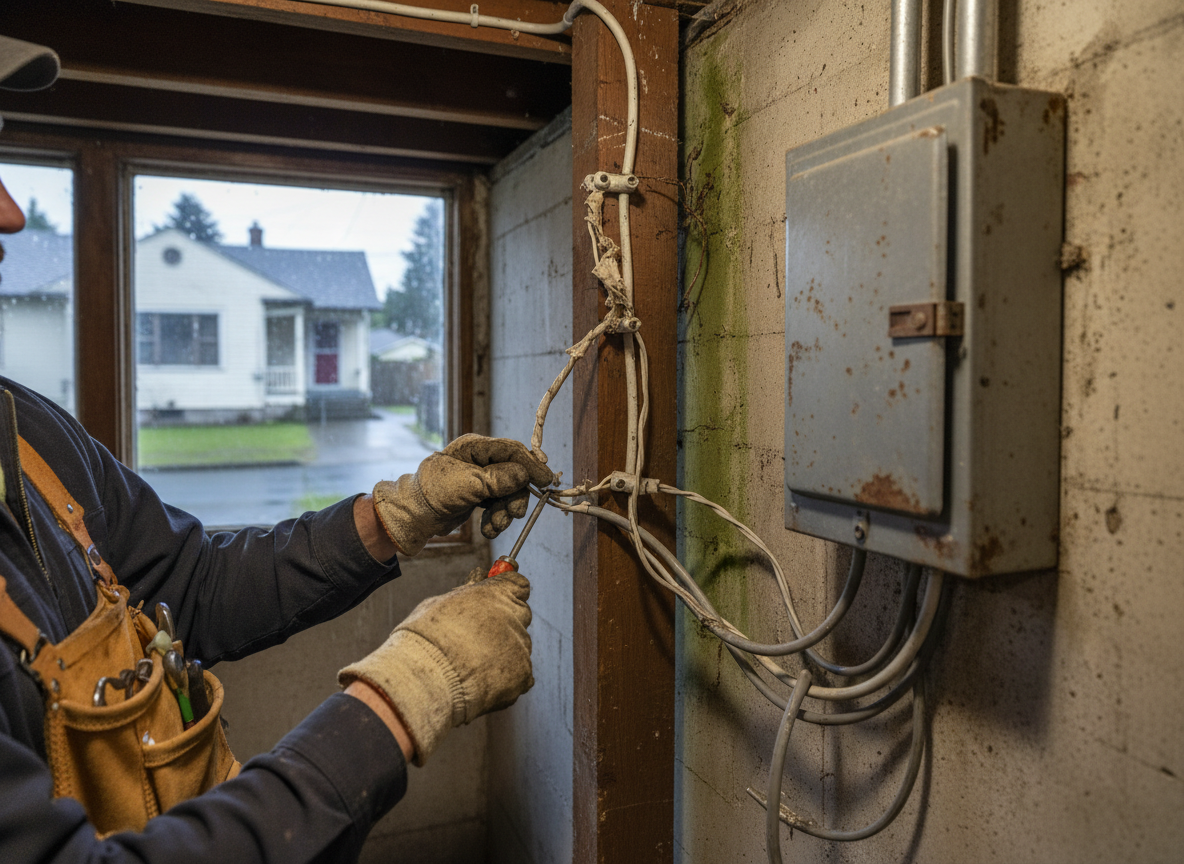
Insurers writing policies on pre 1940 homes ask 3 things about knob and tube wiring: is any of it still active, has it been spliced into modern circuits, and is any of it buried under insulation. Many carriers will insure inactive or limited K&T, but active, buried or amateur-spliced knob and tube triggers exclusions, surcharges or a required replacement before binding coverage.
What Knob and Tube Is and Why It Ages Badly
Knob and tube was the standard wiring method from roughly 1900 into the 1940s, which covers most of the original housing on Portland's inner east side and north side. Hot and neutral run as separate single conductors, held off the framing on ceramic knobs and passed through joists inside ceramic tubes. The conductors themselves are copper, and copper does not wear out. Everything around the copper does.
The insulation is the problem. K&T conductors are wrapped in rubber and cloth insulation that dries, cracks and flakes off after a century, especially near heat sources like ceiling fixtures, where decades of incandescent bulbs baked the last few feet of wire. There is also no equipment grounding conductor anywhere in the system, which is why these houses are full of ungrounded 2 prong outlets, and why a GFCI is the only practical way to add shock protection to these circuits.
The design had one genuine virtue: it was an air-cooled system. The conductors were meant to run in free air with space around them to shed heat. That virtue became a liability when Portland homeowners started blowing insulation into attics and walls. Buried in cellulose or fiberglass, the conductors cannot dissipate heat, the ampacity the wire was rated for no longer applies, and the brittle insulation sits in direct contact with combustible material. Oregon energy upgrade programs generally require the wiring to be inspected or deactivated before insulating over it, precisely because of this.
The other failure mode is splices. Original K&T splices were soldered and taped, and those hold up remarkably well. The dangerous ones are the later additions: a 1970s basement remodel where someone tied NM cable into a live K&T conductor with a wire nut, no junction box, hidden above a suspended ceiling. In our experience those free-air amateur splices, not the original wiring, are where the burn marks show up.
What Insurers Actually Ask
The questions on carrier forms and 4 point style inspections are consistent:
- Is any knob and tube still energized, and roughly what percentage of the house does it serve?
- Has it been evaluated by a licensed electrician, and is there a written report?
- Is any of it in contact with, or buried under, thermal insulation?
- Have circuits been extended or spliced from it, and were those splices permitted and inspected?
- What is the service size and panel type, since a 60 amp fuse panel alongside K&T compounds the risk in the underwriter's model?
Some carriers decline any active K&T. More commonly they will write the policy with a condition: replacement within a set window, often with proof via permit records from Portland Permitting and Development. A documented evaluation from a licensed electrician frequently makes the difference between a standard policy and a declined application, because it converts "unknown old wiring" into a scoped, priced item.
How to Identify Knob and Tube in Your House
Start where the wiring is visible: the basement ceiling and the attic. Look for single conductors, not cables, running in pairs a few inches apart, riding on white ceramic knobs and disappearing through joists in ceramic tubes. In the attic, look along the eaves and around old ceiling fixture boxes.
Do not assume a newer panel means the K&T is gone. This is the most common misdiagnosis we see in Portland. Many inner east side houses got a panel swap in the 1980s or 2000s, and the first 6 feet of wiring at the load center is modern NM cable, spliced to live knob and tube up in the walls. A buyer sees breakers instead of fuses and concludes the house was rewired. The tell is at the devices: 2 prong outlets, or 3 prong outlets that a plug-in tester shows as having an open ground, on circuits that leave the panel as modern cable.
A licensed electrician can confirm what is live with a tracer and by opening a sample of fixture boxes. Expect the assessment to map which circuits are K&T, where splices occur, and whether any of it is under insulation.
What to Do About It and When It Becomes a Safety Issue
Intact, unburied, unmodified knob and tube carrying light loads is not an emergency. It becomes a safety issue when any of these are true: insulation contact, brittle or missing conductor insulation, unboxed splices, circuits feeding heavy modern loads like space heaters or window air conditioners, or repeated fuse blowing that someone "solved" with an oversized fuse. An overfused K&T circuit is the worst case, because the wire can cook inside a wall without ever opening the fuse.
Options run from targeted to complete:
- Deactivate and abandon K&T in areas being insulated, feeding those rooms with new branch circuits.
- Phased rewiring, typically starting with the attic and kitchen circuits, spread over time to manage cost.
- Full rewire with a panel and service evaluation at the same time, since a 60 or 100 amp service is usually undersized for how the house will be used afterward.
All of this is permitted work in Portland with rough in and final inspections, and modern replacement circuits will include AFCI protection, which is specifically aimed at the arcing faults old wiring is prone to. Plaster and lath walls make rewiring here slower than in newer housing, which is why quotes vary widely and why a fixed scope matters.
If an insurer or inspector has flagged knob and tube in your house, we can evaluate what is actually live and give you a written assessment to work from. Our knob and tube evaluation and rewiring service covers everything from the initial mapping to full replacement.
Frequently Asked Questions
Will insurance companies cover a Portland home with knob and tube wiring?
Many will, provided the wiring has been evaluated by a licensed electrician and is not buried in insulation or spliced into modern circuits without permits. Some carriers decline active K&T outright, and others require replacement within a set timeframe as a condition of coverage. A written electrical assessment usually determines which category you land in, so get the evaluation before you shop for the policy.
Is knob and tube wiring illegal in Oregon?
No. Existing knob and tube that is intact and unmodified is legal to leave in service under the Oregon Electrical Specialty Code. What is restricted is extending it, splicing new circuits onto it, and burying it in thermal insulation. New K&T has not been installed for decades. Legal and advisable are different questions, though: a 90 year old ungrounded circuit should not be feeding your home office or kitchen appliances.
How much of my house has to be rewired if some knob and tube is found?
Only the circuits that are actually still live on K&T, which an assessment will map. It is common in Portland homes to find the basement and kitchen were rewired during past remodels while second floor lighting and bedroom circuits remain original. Phased replacement is normal: attic and insulation-contact areas first, heavily loaded circuits next, and the balance on your schedule.