2026-08-31 · Trevor Lindquist
Why 100 Amp Service Cannot Handle a Heat Pump, an EV Charger and a Modern Kitchen
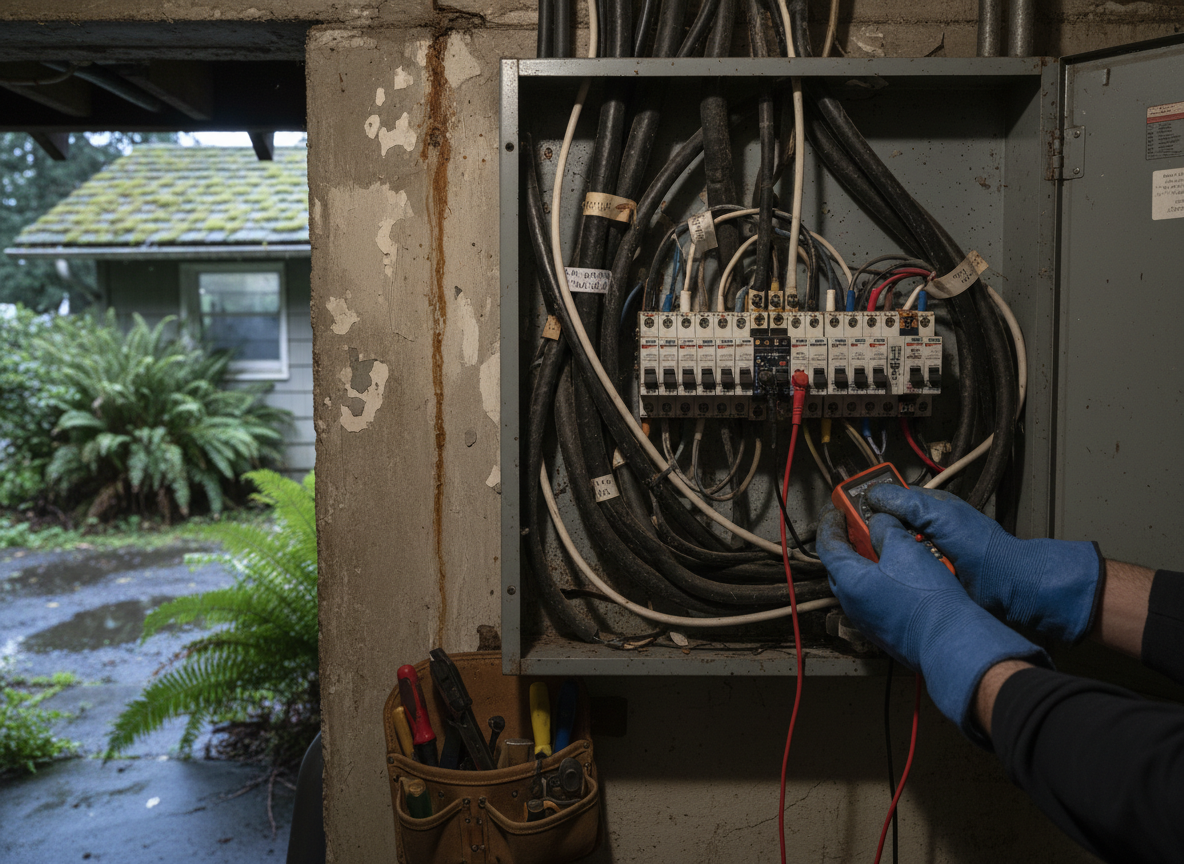
A 100 amp service cannot handle a heat pump, an EV charger and a modern electric kitchen because the arithmetic does not fit: those 3 additions alone can demand 70 to 90 amps of calculated load before you count heat, water heating, laundry or general lighting. The load calculation method in the code makes this concrete, and it is worth walking through.
The Mechanism: What 100 Amps Actually Buys You
Your service size is the ampacity of the path from the utility into your main breaker: the service entrance conductors, the meter base, the panel busbar and the main breaker itself, all rated as a system. At 240 volts, 100 amps is 24,000 watts, 24 kilowatts, available to the whole house at once.
That sounded generous in 1960, when a Portland house had a gas furnace, a gas water heater, a gas range and no air conditioning. The electrical load was lighting, a refrigerator and a washing machine. Many inner Portland homes still run on 100 amps, and plenty on the east side still run on 60, because for decades nothing forced the issue.
Two local shifts forced it. The 2021 heat dome pushed heat pumps and mini splits into thousands of homes that never had cooling, and Portland's EV adoption keeps adding Level 2 chargers, a large share of which need a service or panel upgrade before the charger can go in. Gas to electric conversions for heating and cooking stack more load on top.
The Load Calculation, Worked Through
The Oregon Electrical Specialty Code adopts the NEC calculation methods. Here is the standard method, rounded for readability, on a 1,800 square foot house going all electric:
- General lighting and receptacles: 3 watts per square foot, so 5,400 watts.
- Small appliance and laundry circuits: 2 kitchen circuits plus laundry at 1,500 watts each, 4,500 watts.
- Apply the demand factor: first 3,000 watts at 100 percent, remainder at 35 percent. That trims 9,900 watts to about 5,400 watts.
- Electric range: 8,000 watts after the demand allowance.
- Electric water heater: 4,500 watts.
- Electric dryer: 5,000 watts.
- Dishwasher and disposal: about 1,800 watts.
- Heat pump with electric backup heat: the heating side usually governs. A heat pump compressor around 4,800 watts plus 5,000 watts of supplemental heat strips is roughly 9,800 watts.
- Level 2 EV charger: a 40 amp circuit at 240 volts is 9,600 watts, counted at 100 percent because it is a continuous load.
Total: roughly 44,100 watts. Divide by 240 volts and the calculated load is about 184 amps. Even the optional calculation method, which discounts more of the load, lands well above 100 amps for this house. The conclusion is not close.
Strip it down to just the 3 headline items and the point still stands: 9,800 watts of heat pump and backup heat, 9,600 watts of EV charging and 8,000 watts of range come to 27,400 watts, about 114 amps, before a single light turns on.
How to Identify Whether Your Service Is Already at Its Limit
Start at the panel. The main breaker's handle is stamped with the service size: 100, 125, 200. No main breaker and a bank of fuses usually means 60 amps. Then look at the symptoms of a service being pushed:
- The main breaker trips when the dryer, oven and heat strips run together, typically on a cold evening.
- Lights dim noticeably when big loads start, a voltage drop signature.
- The panel is physically full, with tandem breakers squeezed in or, worse, 2 wires under 1 breaker, a double tap.
- A warm main breaker or a faint hot smell at the panel, which means stop and call someone now.
One Portland-specific wrinkle we see constantly: the panel is in the basement or an interior utility room, not on an exterior wall. That affects how a service upgrade gets routed and priced, because the new service mast, meter base and conductors have to reach an interior load center, and current code rules on emergency disconnects favor equipment at the exterior. It is a routing question a generic online calculator never mentions, and it is often the biggest cost variable in the quote.
The honest diagnostic is a written load calculation. Any licensed electrician proposing a heat pump circuit or EV charger should produce one, and Portland Permitting and Development expects the numbers to work when the permit is reviewed.
What to Do About It and When It Becomes a Safety Issue
You have 3 realistic paths:
- Upgrade the service to 200 amps. The standard fix: new service entrance conductors, meter base, main panel, and grounding brought up to current code, including the grounding electrode conductor and bonding. This is the clean answer if you plan to electrify heating, cooking and driving. Coordination with PGE or Pacific Power for the disconnect and reconnect is part of the job. Our 200 amp service and panel upgrades handle the whole sequence, utility coordination included.
- Manage the load instead of enlarging it. An energy management system or load-sharing EV charger pauses charging while the range or heat strips run. A 100 amp service with load management can legitimately support an EV charger under current code allowances, and for some households this defers the upgrade for years.
- Right-size the charger. Not every driver needs 40 amps of charging. A 16 or 20 amp Level 2 circuit adds 25 to 35 miles of range per hour of charging and fits a smaller calculated load.
It becomes a safety issue when the workarounds start: an oversized main breaker on old conductors, double taps, or a melted neutral lug from years of running near capacity. Heat at the service equipment is cumulative. Connections that run hot loosen, loose connections run hotter, and the failure point is usually the busbar or the meter base lugs, not the breaker that was supposed to protect them.
If you are planning a heat pump or a charger and want the real number for your house, we can run the load calculation and tell you whether your service passes before any equipment gets ordered.
Frequently Asked Questions
Can I install a Level 2 EV charger on a 100 amp service?
Sometimes, and a load calculation is what decides it. A house with gas heat, gas water heating and a gas range often has enough headroom for a 32 or 40 amp charger on 100 amps. An all electric house usually does not, and either needs a load management device that throttles charging when other loads run or a service upgrade. Guessing is not an option: the calculation is required at permit time anyway.
How do I find out what size my electrical service is?
Read the number stamped on the main breaker handle in your panel: 100, 125 or 200 amps is typical. Confirm it against the equipment, because the main breaker rating only tells the truth if the conductors and meter base match it. Fuse panels with no main breaker usually indicate a 60 amp service. If the panel label is missing or the equipment looks mismatched, have a licensed electrician verify before adding load.
Does a heat pump always require a service upgrade in an older home?
No. A right-sized heat pump replacing electric resistance heat can actually lower the calculated load, since heat strips draw more than a compressor. The upgrade becomes necessary when the heat pump is added on top of other new loads, an EV charger, an electric range, a heat pump water heater, or when the existing service is 60 amps. The load calculation for your specific house settles it, not a rule of thumb.