2026-08-31 · Trevor Lindquist
Why Breakers Trip During the First Real Heat Wave of the Summer
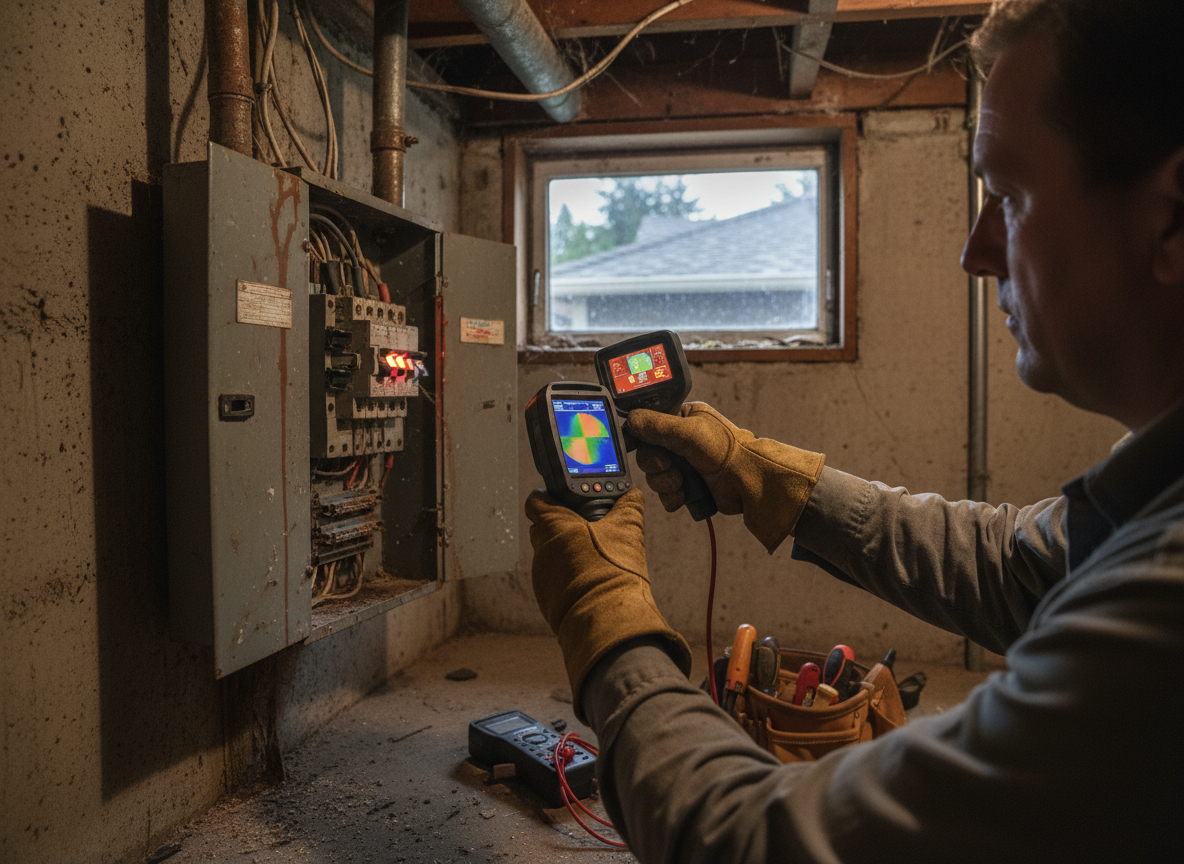
Breakers trip during the first heat wave because 3 factors stack: thermal breakers in a hot garage or attic trip at lower current than their rating, air conditioning inrush lands on circuits already carrying summer loads, and loose terminations that ran cool all spring start generating heat of their own. The pattern tells you which problem you have.
The Mechanism: Your Breakers Are Thermometers
A standard residential circuit breaker is a thermal magnetic device. The magnetic element reacts instantly to the huge current of a short circuit. The thermal element is a bimetal strip that bends as current warms it, tripping the breaker on sustained overload. That thermal element cannot tell the difference between heat from current and heat from its surroundings. Breakers are calibrated at 104 degrees Fahrenheit ambient, and above that they derate: they trip at less than their marked rating.
Now picture where Portland panels actually live. Basements stay cool, but plenty of load centers sit in garages and utility rooms that hit 100 to 120 degrees during a heat dome afternoon, and the panel interior runs hotter still with every busbar and breaker under load contributing warmth. A 20 amp breaker in a 115 degree garage may open at 17 or 18 amps. The circuit that ran your shop, freezer, and fans all spring without complaint now trips at 4 pm on the first hot Saturday, with nothing wrong except the math.
Stacked on top is inrush current. An air conditioner or heat pump compressor draws 3 to 6 times its running current for the fraction of a second it takes to start. A window unit on a bedroom circuit that is also running a TV and fans presents a starting spike to a breaker that is already warm and already derated. That combination, marginal load plus inrush plus ambient heat, is the classic first heat wave nuisance trip.
There is a Portland specific twist: after the 2021 heat dome, cooling arrived in thousands of houses that never had it, much of it window units and portable ACs plugged into branch circuits wired in the 1920s through 1960s for lamps and radios. Circuits, and in the oldest homes knob and tube wiring and 60 to 100 amp services, are being asked summer questions they were never sized to answer.
The Dangerous Version: Loose Terminations
Not every summer trip is innocent. Every place a conductor lands on a screw or lug, at the breaker, the neutral bar, outlets, or splices, is a potential loose termination, and connections loosen over years of thermal cycling as copper expands and contracts. Aluminum branch wiring, present in many Portland homes from the mid 1960s to mid 1970s, is worse because aluminum expands more and cold flows under pressure.
A loose connection has resistance, and resistance under current makes heat. In mild weather with light loads, a slightly loose lug runs warm and gets away with it. In a heat wave, current goes up, ambient goes up, and the connection can climb hundreds of degrees, cooking insulation and arcing. Sometimes the adjacent breaker trips from the heat. Sometimes nothing trips at all, because a glowing connection is not an overload and not a short; the current never exceeds the rating. That is how panels and outlets burn without a single breaker opening, and it is why heat plus a burning smell is an emergency, not a nuisance.
How to Diagnose What Kind of Trip You Have
Read the pattern before resetting anything twice:
- Trips only on hot afternoons, on circuits feeding cooling or heavy use rooms, and holds fine at night. Classic overload plus derating. Count what is on the circuit: a 1,500 watt portable AC is 12.5 amps by itself, most of a 15 amp circuit.
- Trips instantly the moment you reset, with a snap. That is the magnetic element seeing a short circuit or ground fault. Stop resetting. Unplug everything on the circuit; if it still snaps open, the fault is in the wiring.
- The main breaker trips, not a branch. The whole service is overloaded, common when a heat pump, EV charger, range, and dryer overlap on an older 100 amp service. This is a load calculation conversation, not a breaker problem.
- AFCI or GFCI device trips. Note whether the small indicator flags an arc or ground fault; repeated arc fault trips on a hot day in an older home deserve investigation rather than a swap to a standard breaker.
- Warmth, smell, or discoloration. Feel the panel cover, carefully, and the breaker faces. A breaker distinctly hotter than its neighbors, a hot outlet where the AC plugs in, brown or bubbled cover plates, or any burnt smell points to a termination problem. So does a breaker that feels crunchy or soft when switched.
One more local note: if your panel is a Federal Pacific Stab-Lok or Zinsco, common in the mid century neighborhoods, take no comfort from breakers that never trip. Those brands are documented for failing to open under overload, and a quiet panel under heavy summer load may simply not be protecting you.
What to Do About It and Where the Safety Line Sits
For genuine overloads, the fixes run from free to structural: move the portable AC to a less loaded circuit, stagger big loads so the oven and the AC do not start together, add a dedicated 20 amp circuit for the room with the window unit, typically a few hundred dollars with permit and inspection through Portland Permitting and Development, or upgrade the service if the main is the one tripping. Hardwired mini splits on dedicated circuits, sized from the nameplate, end the window unit problem entirely.
For everything else, the line is bright. A breaker may be reset once after you have unplugged the likely cause. A breaker that trips immediately on reset, any burning smell, a warm panel cover, buzzing or sizzling from the panel, or visible scorching means leave it off and call. Resetting into a fault or a glowing connection during 100 degree weather is how a nuisance becomes a fire, and breakers that have tripped repeatedly under heat can themselves be degraded and worth replacing. An electrician's visit for chronic summer tripping typically includes checking torque on terminations, looking for double taps and backstab connections, and thermal imaging of the panel under load, which finds the hot lug you cannot see.
Electrician Portland Oregon is a licensed and insured, owner operated contractor available 24 hours for troubleshooting and electrical repair, and if this summer's first hot week has your breakers acting up, we can find out why.
Frequently Asked Questions
Why does my breaker only trip when it is hot outside?
Because standard breakers are thermal devices that trip at lower current when their surroundings are hot, and summer is also when circuits carry their heaviest loads. A breaker in a 115 degree garage can open at 10 to 15 percent below its marked rating, so a circuit that runs at 16 or 17 amps all spring trips on a 20 amp breaker during a heat wave. Add air conditioner starting current and the trip becomes predictable.
Is it safe to keep resetting a breaker that trips?
No, one reset after removing the likely cause is reasonable, but repeated resetting is not. If the breaker snaps off instantly on reset, the magnetic element is seeing a short circuit and each reset pushes fault current through the wiring again. If it trips after minutes under load, unplug devices and redistribute them first. Repeated tripping with a burning smell, warmth at the panel, or scorching is the point to stop entirely and call a licensed electrician.
Can a circuit be dangerous even if the breaker never trips?
Yes, a loose or corroded termination generates intense heat at normal current, and since the current never exceeds the breaker's rating, nothing trips while the connection cooks. This is how outlets and panel lugs burn silently, and it is the specific failure aluminum branch wiring from the 1960s and 1970s is known for. Warm cover plates, buzzing, flickering on one circuit, or a fishy or burnt odor are the warnings that matter more than trip history.