2026-08-31 · Trevor Lindquist
What Winter Windstorms and Ice Do to Service Masts and Overhead Drops
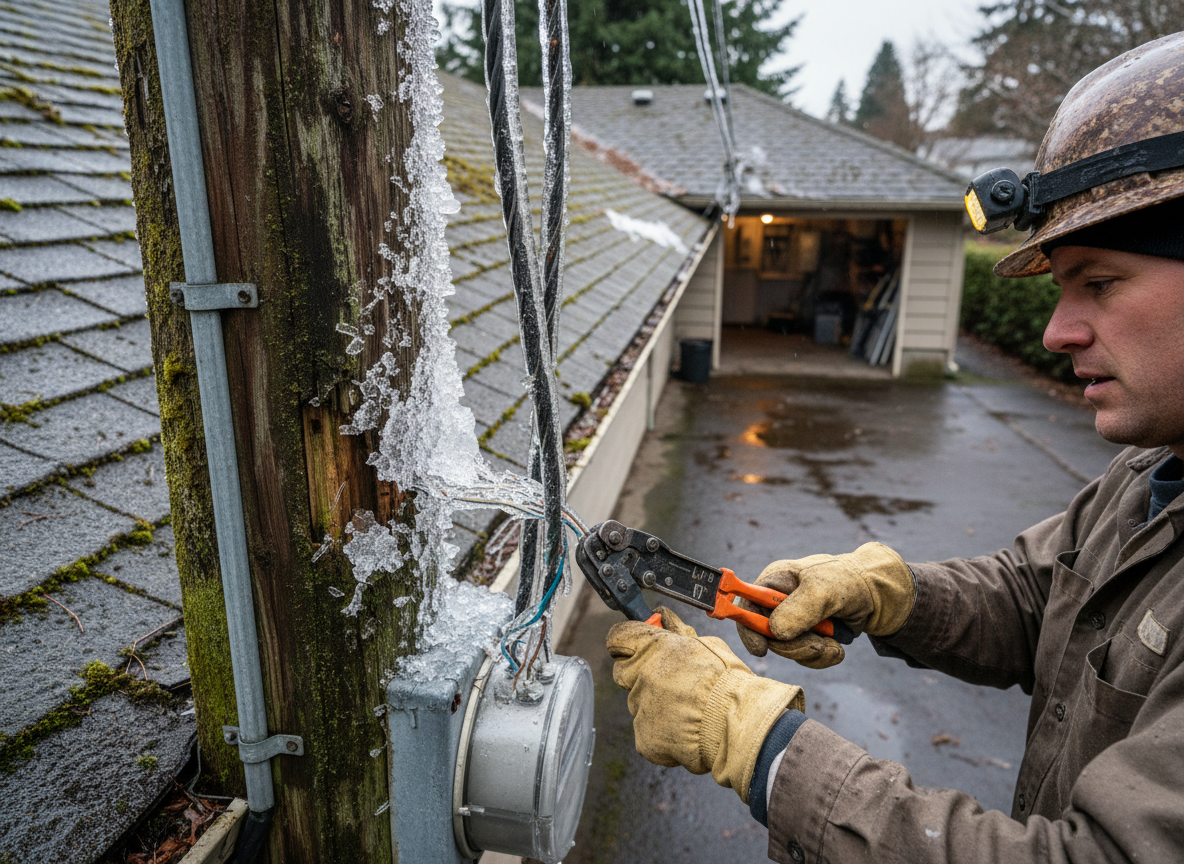
Winter windstorms and ice put mechanical load on the overhead service drop, and the drop transfers that load to your service mast, weatherhead and attachment hardware. Falling limbs and ice weight tear drops, bend masts at the roofline and rip anchors out of fascia boards. The utility repairs the drop; the mast and everything attached to the house is the homeowner's repair.
The Mechanism: How Wind and Ice Break Service Equipment
The service drop is a cable spanning from a pole to your house, and like any span it lives under tension. Three things multiply the force on it during Portland's storm season:
- Wind loading. Gusts make the span swing and gallop, cyclically yanking on the splices at the weatherhead and on the attachment point. Every cycle works connections a little looser.
- Ice loading. A coating of ice can multiply the weight of the span several times over. Ice storms east of the city, where gorge winds bring freezing rain into east Portland neighborhoods more often than the west side, produce exactly this: drops sagging under ice until the attachment hardware or the mast gives.
- Tree strikes. Portland's mature canopy is the biggest single factor. A limb dropping across a span delivers a shock load nothing in the system was sized for. Sometimes the drop breaks. Often the drop holds and the mast takes the force instead, bending at the roof penetration or tearing the flashing open.
The mast is the weak point more often than people expect. A mast that penetrates the roof acts as a lever: force applied at the top, several feet above the roof, concentrates at the roofline. An unbraced mast, or one made of thin-wall conduit instead of rigid metal conduit, folds there. Once the mast tilts, the roof flashing opens, and every subsequent rain runs down the mast into the meter base and sometimes into the service panel. That slow water damage after a storm is a bigger long-term problem than the visible tilt.
There is a hidden electrical failure mode too. When a drop gets yanked hard but nothing visibly breaks, the neutral conductor or its splice can be damaged while the 2 hot legs survive. A compromised service neutral shows up as lights going bright in one part of the house and dim in another, and it cooks electronics. It is one of the few residential symptoms that justifies an immediate call, because voltage on half the house can climb well above 120.
How to Identify Storm Damage After the Wind Dies Down
Walk the outside of the house and look up. From the ground, without touching anything, check:
- The span. Is the drop intact, at normal height, and clear of limbs? Anything resting on it, even a small branch, deserves a call to the utility.
- The attachment point. Is the bracket still fastened to the house, or is it hanging, with the drop's tension now carried by the conductors themselves?
- The mast. Is it plumb? Compare it to photos, siding lines or the chimney. Any new lean or bend at the roofline is damage.
- The weatherhead and drip loop. The weatherhead should point down and the conductors should hang in a loose loop. A tight, straight drip loop means the drop has pulled the slack out, a sign the span took a hit.
- The flashing. Lifted or torn flashing where the mast passes through the roof means water is already getting in.
- Inside. Flickering across many circuits, or the bright-dim pattern described above, points at the service connections even when nothing looks wrong outside.
Take photos of everything before repairs. Storm damage to a mast is frequently covered by homeowner's insurance, and documentation from the day of the storm makes the claim straightforward.
What to Do About It and When It Becomes a Safety Issue
The safety rules come first. A downed line, or a drop lying on a car, fence or the ground, is treated as energized no matter how dead it looks. Keep people and pets away and call PGE, or Pacific Power in parts of west and southwest Portland. A mast torn off the house with conductors still attached can energize gutters, downspouts and metal siding. Do not touch, do not prop it up, do not throw a rope over it.
Then the repair sequencing, which surprises homeowners every storm season. The utility owns the drop and its splices and repairs them at no charge. But the utility will not reconnect a drop to a damaged mast or a torn-out attachment point. The sequence after real damage is: a licensed electrician repairs or replaces the mast, weatherhead, service entrance conductors and attachment hardware under an emergency permit from Portland Permitting and Development, the city inspects, the release goes to the utility, and the utility reconnects. During a multi day outage event after a major storm, electricians, inspectors and utility crews are all working the same backlog, which is why a prepared homeowner who calls early gets power back days ahead of one who waits.
A rebuilt mast should come back better than it went down: rigid metal conduit sized for the span, proper bracing and guying where the span length demands it, new flashing, and connections re-torqued. Under the Oregon Electrical Specialty Code the repair also brings grounding and bonding up to current requirements. If the service is an old 60 or 100 amp, this is the natural moment to upgrade to 200 amps, since most of the expensive components are being replaced anyway. It is also the moment many storm-weary homeowners add a transfer switch or an interlock kit for a generator, so the next multi day outage is an inconvenience instead of a crisis.
Minor findings, a slightly tight drip loop, aged flashing, a weathered but plumb mast, can wait for scheduled work. Anything bent, torn, arcing, buzzing or leaking water into the meter base should be looked at now, because these failures compound with every storm that follows.
If a storm has left your mast leaning or your drop torn away, we handle these repairs year round and can coordinate the permit, inspection and utility reconnect for you. Our storm damage repair for service masts and weatherheads runs around the clock during outage events.
Frequently Asked Questions
Who do I call first when my power line is pulled off the house?
Call the utility first, PGE for most of Portland, any time the drop itself is down, torn or arcing, because only they can de-energize and repair their line, and a downed drop is a life safety hazard. Call an electrician next if the mast, weatherhead or attachment point on the house is damaged, since the utility will not reconnect until that homeowner-owned equipment is repaired, inspected and released.
Does homeowner's insurance cover a storm damaged service mast?
Often yes, because the mast, weatherhead, service entrance conductors and meter base are part of the dwelling, and wind and falling tree limbs are covered perils on most policies. Deductibles apply, so smaller repairs may not clear them. Photograph the damage the day it happens, keep the electrician's invoice and permit record, and check whether your policy also covers code-required upgrades, since the repair must meet current code.
Can I keep using power if my mast is bent but the lights still work?
Use it cautiously and get it evaluated quickly, because a bent mast means the conductors and their splices took mechanical strain even if everything works today. Watch for flickering, or lights going bright in one room and dim in another, which signals a damaged neutral and justifies shutting off sensitive electronics and calling immediately. A bent mast also usually means torn flashing, so water is entering the system with every rain.