2026-08-31 · Trevor Lindquist
Seismic Mounting and Support for Electrical Equipment in the Pacific Northwest
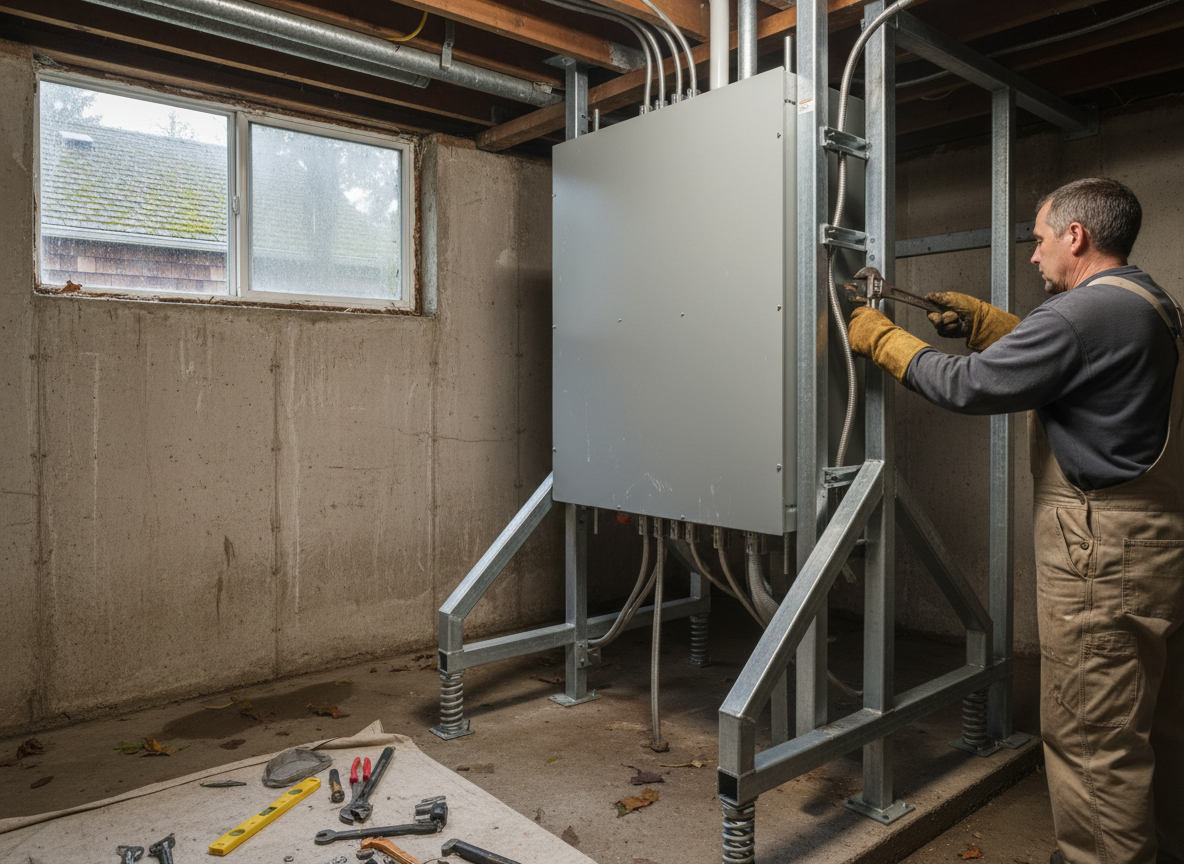
Seismic mounting for electrical equipment means 3 things: anchoring panels, generators, and transformers so they cannot slide or topple, bracing conduit and raceway runs so they move with the structure, and using flexible connections where equipment and building can move differently. In the Pacific Northwest, sitting above the Cascadia subduction zone, this is a design requirement, not an extra.
The Mechanism: What Shaking Actually Does to Electrical Systems
An earthquake does not push a building once. It reverses direction several times a second, and in a Cascadia subduction event the shaking may continue for 3 to 5 minutes. Equipment responds according to its mass and how it is attached. A service panel screwed to plywood rides with the wall. A 400 pound standby generator resting on a pad with no anchorage becomes a sled: it walks, and when it walks it tears out its fuel line, its feeder conduit, and its bonding connections. A water heater without straps does the same thing on a smaller scale, which is why Oregon has required water heater strapping for decades. The same physics applies to every heavy electrical box nobody thought to anchor.
The second failure mode is differential movement. Rigid conduit entering a rigidly mounted transformer from a structure that flexes will concentrate all the motion at the connector, and the connector loses. The fix throughout seismic design is a deliberate soft link: flexible metal conduit or liquidtight whips at equipment connections, slack in conductors, and expansion fittings where raceways cross building seismic joints.
The third is unbraced distribution. Long horizontal runs of EMT, cable tray, or suspended busway swing like pendulums. Sway multiplies at couplings and pulls boxes off their screws. Strut channel, the slotted steel framing electricians use everywhere, becomes the seismic skeleton: trapeze supports with diagonal brace members back to structure, at intervals set by the run's weight, so the raceway moves with the building instead of against it.
Why the stakes are high for this trade specifically: after a major quake, torn service conductors and displaced panels are ignition sources exactly when fire response is overwhelmed, and a generator that shifted off its connections fails at the moment it was installed for.
What This Looks Like in Portland Homes and Small Buildings
The local building stock shapes the problem. Portland panels overwhelmingly live in basements, garages, and unfinished utility rooms rather than on exterior walls, and a large share of the pre 1940 housing on the inner east side and north side sits on unreinforced or partially reinforced foundations. Two consequences follow:
- If the house itself shifts on its foundation, the service equipment goes with the structure while the meter base, service mast, and utility drop stay put or move differently. Homes that have been seismically retrofitted, bolted to their foundations, protect their electrical systems as a side effect. Homes that have not can shear their own service entrance.
- Basement and garage mounting means equipment is often on masonry or concrete, where anchorage means proper concrete anchors, not the plastic sleeves and drywall screws we routinely find holding transfer switch cabinets and even subpanels.
The equipment that deserves the most attention:
- Standby generators. The heaviest and most consequential item. Correct installation anchors the unit to its concrete pad with rated anchors, uses flexible fuel connections, and enters the transfer switch with flexible conduit. Portland's windstorm and ice storm outages have driven steady generator installs since the region's multi day outages, and a generator mounted for convenience rather than motion is common.
- Panels and subpanels. Fastened to solid backing with proper screws into framing or anchors into concrete, with a bit of slack in the entering cables.
- Battery storage systems. Wall mounted home batteries weigh 200 to 350 pounds. Manufacturer seismic mounting patterns exist for a reason, and every lag must land in structure, not drywall.
- Suspended raceway and lighting in shops, garages, and commercial spaces: braced trapezes, safety wires on lay in fixtures, sway bracing on long runs.
How to Check What You Have
A homeowner can do a useful first pass:
- Grab the edges of the panel cabinet, gently, with the cover on, and see if the enclosure flexes away from the wall. Any visible gap or movement means inadequate fastening.
- Look at your generator or battery: are there bolts through its feet into concrete, or is it resting on rubber pads and gravity?
- Follow conduit runs in the basement or garage. Straps every few feet into solid material is good. Runs supported by plumbing pipes, or 10 foot horizontal stretches with 1 strap, are not.
- Check the service mast where it passes through the roof and the clearance and condition of the weatherhead. A mast already loose in its flashing will not survive shaking plus a torqued service drop.
- Note anything heavy stored on shelves above the panel. Falling objects that block working clearance are a post quake access problem for you and for responders.
An electrician's inspection adds torque checks on terminations, verification of bonding jumpers across flexible fittings, since a flex connection still must carry fault current, and a look at the grounding electrode conductor routing, which should not be a tripping hazard or a tension member.
What to Do About It and When It Is a Safety Issue
Most corrections are inexpensive relative to what they protect: anchoring a generator, re fastening a panel, adding strut bracing to long runs, and swapping rigid final connections for flexible ones are typically a day of work, not a remodel. Bundle the work with other triggers: a panel replacement, a standby generator installation, a battery install, or a seismic retrofit of the house itself are all natural moments, and new equipment installations should simply be done this way from the start, with permits through Portland Permitting and Development where the work requires them under the Oregon Electrical Specialty Code.
It becomes an immediate safety issue in 3 cases: a generator or battery with no anchorage at all, a panel enclosure loose enough to move by hand, and any equipment where a prior event, even a foundation settling episode or a vehicle bump in the garage, has already stressed the connections. After any earthquake large enough to feel, smell for ozone or hot insulation, look for a shifted mast or drooping service drop, and treat either as a call before you reset a single breaker.
Electrician Portland Oregon is a licensed and insured, owner operated contractor, and we can assess the anchorage and bracing of your electrical equipment during any service visit.
Frequently Asked Questions
Does my standby generator need to be bolted down?
Yes, a standby generator should be anchored to its pad with rated concrete anchors and connected through flexible fuel and electrical connections. In shaking, an unanchored generator slides, and the failure point is the rigid gas line or conduit it tears away from, creating a fuel leak and a wiring fault at once. Anchorage hardware costs very little compared to the generator, and manufacturers publish the required bolt patterns in the installation manual.
Is seismic bracing of electrical equipment required by code?
Yes, the codes in force in Oregon require electrical equipment to be secured to the structure, and heavier equipment and commercial installations carry explicit seismic design requirements tied to the region's seismic category. In practice, residential enforcement focuses on proper fastening of panels, generators, and batteries and adequate support of raceways. The Pacific Northwest's Cascadia exposure is exactly why inspectors here pay attention to anchorage details that might slide in calmer regions.
What is a flexible connection and why does it matter in a quake?
A flexible connection is a short section of flexible metal conduit, liquidtight whip, or flexible fuel line installed where wiring or piping meets equipment, allowing the equipment and structure to move differently without tearing the joint apart. Rigid connections concentrate seismic motion at the connector, which fails first. The flex section must still be properly bonded so it can carry fault current, which is a detail do it yourself installations often miss.