2026-08-31 · Trevor Lindquist
Moisture, Crawlspaces and Corroded Panels: A Wet Season Problem in Portland
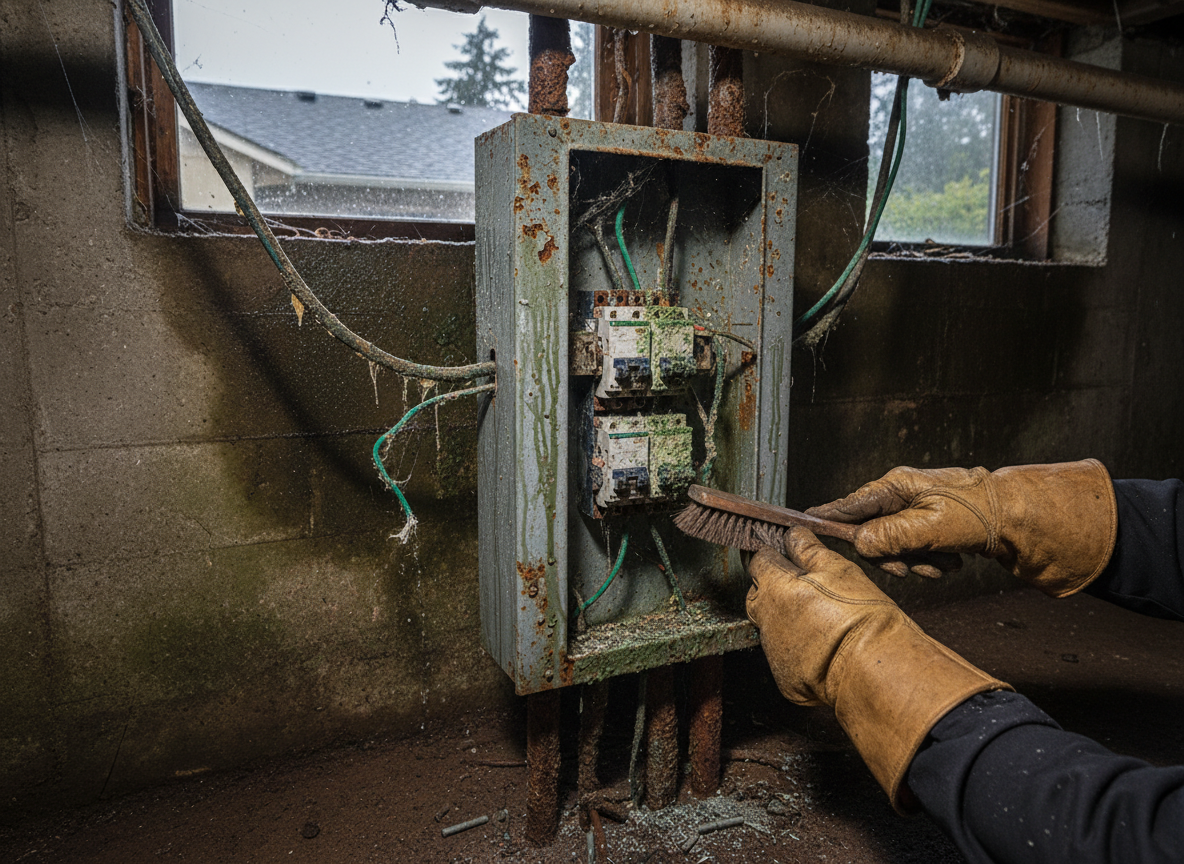
Moisture corrodes electrical equipment by attacking connections: damp air and water intrusion oxidize copper lugs, rust steel enclosures and grow green corrosion on busbars and neutral bars. In Portland, where the wet season runs roughly October through May and panels commonly sit in basements, garages and crawlspace-adjacent utility rooms, corrosion is a slow, cumulative failure mechanism worth checking annually.
The Mechanism: Why Damp Air Ruins Electrical Connections
Electricity wants clean, tight, low-resistance metal-to-metal contact. Corrosion is the opposite: an oxide layer that conducts poorly. As oxide builds on a lug, a breaker stab or a neutral bar screw, resistance at that joint rises. Current through resistance makes heat. Heat expands and loosens the joint, which raises resistance further, and the cycle feeds itself until the connection chars, arcs or burns open. This is the same progression whether the trigger is a loose screw or a wet winter, and it is why a corroded connection is not a cosmetic issue.
Water reaches Portland's electrical equipment by 3 main routes:
- Direct intrusion from above. Water follows the service entrance conductors like a wick. A cracked weatherhead, failed service mast flashing, or an unsealed opening in the meter base lets rain track down the conductors into the meter base and onward into the main service panel. The tell is rust staining directly below the top conductor entries inside the panel.
- Condensation. A panel on the cold exterior wall of an unheated basement or garage sweats when humid interior air meets cold steel. Months of this produces general surface rust, corroded breaker stabs and a musty enclosure with no single leak to find.
- Crawlspace humidity. Portland crawlspaces sit over damp soil for 8 months of the year. Junction boxes, splices and cable runs down there live at high humidity constantly, and any box missing its cover, or any splice made outside a box, corrodes freely. Standing winter water in a crawlspace can submerge boxes outright.
The equipment most affected lines up with the housing stock. Older east side houses have panels in basements that were never dry, mid century houses have garages that breathe outdoor air, and meter bases from the 1960s and 1970s have had 50 winters to fail at their gaskets.
How to Identify Moisture Damage Before It Becomes a Failure
You can see most of this without removing the panel cover, and the interior checks belong to a licensed electrician:
- Rust streaks or mineral staining on the panel face or the meter base, especially below the top edge.
- Green or white crusty deposits, corrosion products, visible at the main lugs or where conductors enter.
- A damp or musty smell when the panel door opens.
- Breakers that feel stiff, or that trip during long wet stretches and behave in summer.
- GFCI devices on garage, exterior or crawlspace circuits tripping repeatedly in winter. This is diagnostic, not just annoying: moisture in a box or fitting leaks current to ground, and the GFCI is reporting it.
- In the crawlspace: boxes without covers, corroded cable connectors, romex sitting on soil, or watermarks showing seasonal flooding above box height.
Two field observations that generic checklists miss. First, when we open a rusty panel in a Portland basement, the first thing we check is not the panel, it is the weatherhead and mast flashing above it, because in a large share of cases the water started at the roof and the panel is just where it landed. Fixing the panel without sealing the entry path buys you 1 dry year. Second, seasonal GFCI tripping that starts every October and stops in May almost always traces to an exterior or crawlspace box taking on water, and finding that one box is the whole job.
A related item on older services: the grounding electrode conductor and its clamps corrode too. A ground connection that has rotted at the ground rod or at the water pipe bonding clamp still looks connected while providing a poor path, and it only reveals itself when it is needed during a fault or a surge.
What to Do About It and When It Becomes a Safety Issue
Prevention is mostly about sealing the paths and drying the spaces:
- Have the weatherhead, mast flashing and meter base gasket inspected and sealed before the rains start. This is a small job in September and an expensive one in January.
- Correct crawlspace conditions: covers on every box, splices only inside boxes, cable supported off the soil, and a vapor barrier or drainage work where the crawlspace floods. Code requires damp-rated treatment for these locations, and the Oregon Electrical Specialty Code governs how it gets corrected.
- Where a panel sweats from condensation, address the environment, heat, ventilation or a dehumidifier, alongside any electrical repair, or the new equipment corrodes on the same schedule as the old.
- During any panel work, connections get cleaned, inspected and torqued to spec, and a surge protective device is cheap to add while the panel is open.
Repair versus replace depends on depth. Surface rust on an enclosure with clean lugs and bus is maintainable. Corrosion on the busbar itself, rusted breaker stabs, or any evidence of water actively entering the enclosure is replacement territory, because a compromised bus cannot be reliably repaired and new breakers on a pitted bus inherit the bad connection. A corroded meter base is likewise replaced, not patched, and that work is permitted through Portland Permitting and Development and coordinated with PGE, or Pacific Power in parts of west and southwest Portland, for the disconnect and reconnect. Our corroded panel and meter base replacement work handles the permit and the utility coordination as part of the job.
It becomes a safety issue when heat or current leakage shows up: scorch marks, a warm panel face, buzzing or sizzling, breakers that will not reset, tripping GFCIs that will not hold, or any standing water in contact with electrical equipment. A submerged junction box or a panel that has taken real water should be treated as an active hazard, de-energize the affected circuits and get it inspected before putting them back in service.
If your panel is showing rust, or your GFCIs start their winter tripping ritual every fall, we can trace where the moisture is getting in and fix the cause along with the damage.
Frequently Asked Questions
Is rust on my electrical panel dangerous or just ugly?
It depends on where the rust is. Surface rust on the outside of the enclosure is a warning sign but not itself a hazard. Rust streaks below the conductor entries, corrosion on the lugs, neutral bar or busbar, or dampness inside the enclosure mean water is reaching live connections, and that is a genuine fire and shock risk. Have the interior inspected: the visible rust is usually the smallest part of the story.
Why do my GFCI outlets trip more in winter?
Because moisture is leaking current to ground somewhere on the circuit, and the GFCI is doing its job by reporting it. Portland's wet season saturates exterior boxes, garage receptacles and crawlspace junction boxes, and a box taking on water leaks enough current to trip a GFCI that holds fine all summer. The fix is finding and sealing or replacing the wet box and fittings, not swapping the GFCI or, worse, removing the protection.
Should electrical boxes in my crawlspace be sealed against moisture?
Every crawlspace box must have a cover, every splice must be inside a box, and equipment in damp locations must be rated for the environment, with cables supported off the soil. Fully sealing boxes is not the goal: correct covers, damp-rated fittings and fixing the crawlspace moisture itself, through vapor barrier and drainage work, do more than sealant. An electrician can correct the wiring side in a single visit for most houses.