2026-08-31 · Trevor Lindquist
Federal Pacific and Zinsco Panels in Portland Homes and How to Identify One
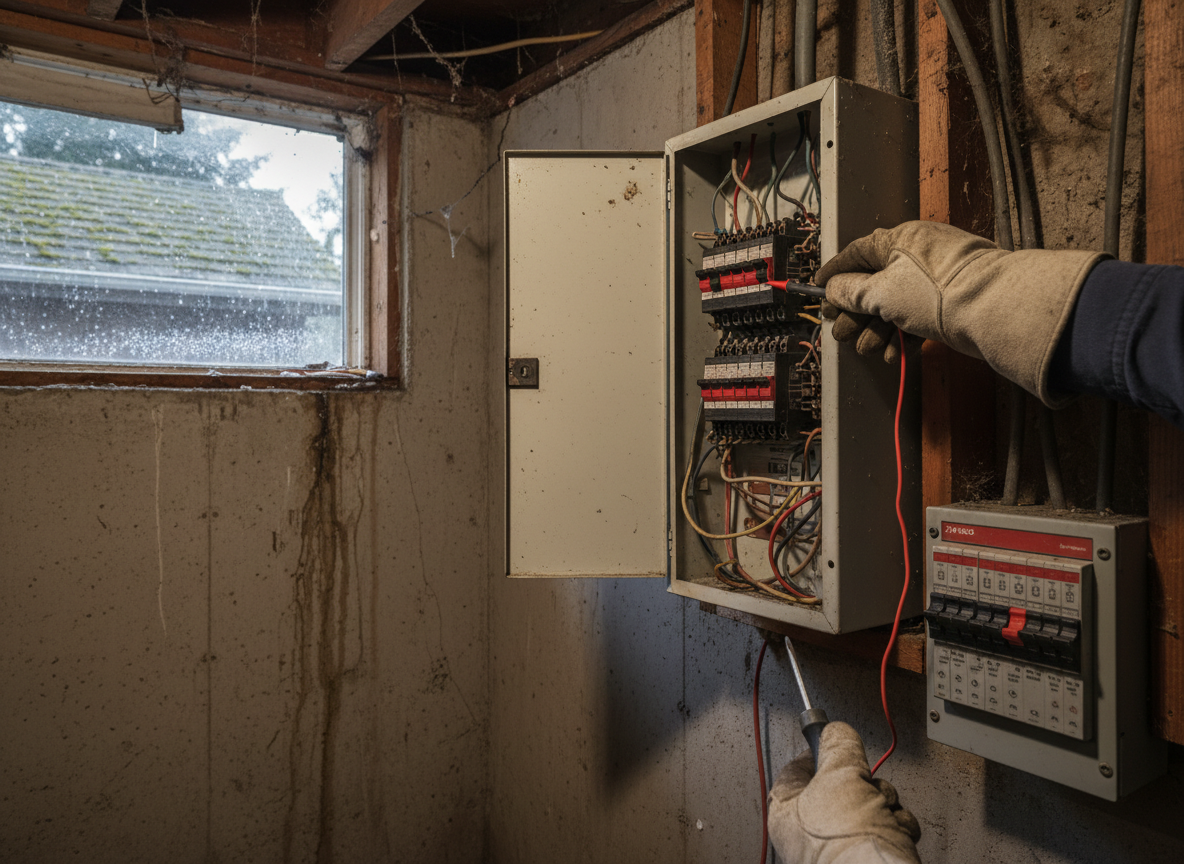
You identify a Federal Pacific panel by the Stab-Lok name on the label and its red-striped breaker handles, and a Zinsco panel by the Zinsco or Sylvania-Zinsco label and its colored breakers in blue, red and green. Both brands have documented failure histories, breakers that do not trip under overload, and both warrant evaluation for replacement.
Why These 2 Brands and Not Just Old Panels in General
Age alone does not condemn a service panel. These 2 brands are singled out because of how they fail, not just how old they are.
A circuit breaker has 1 safety job: open the circuit when current exceeds the rating, whether from a sustained overload or a dead short. Independent testing of Federal Pacific Stab-Lok breakers found unacceptably high failure-to-trip rates, with some 2 pole breakers failing to open in a large share of tests. A breaker that will not trip is worse than a fuse and no better than a solid copper bar: the wire in the wall becomes the fuse, and the wire loses. Stab-Lok breakers also suffer from a weak connection design where the breaker stabs onto the busbar, and they are known to fail internally while the handle still sits in the on position, so the switch position tells you nothing about whether protection exists.
Zinsco panels fail differently. Their breakers connect to an aluminum busbar with a design prone to loosening and corrosion at the connection. The high-resistance joint overheats, the busbar pits and burns, and breakers literally weld themselves to the bus. A welded Zinsco breaker can no longer physically open, and it is common to pull one and find the bus behind it burned away. Portland's wet season is unkind to these panels: months of damp basement and garage air feed exactly the corrosion that starts the sequence.
Both brands were installed heavily in mid century neighborhoods and 1960s and 1970s construction, so east side ranches, split levels and additions from that era are where we find them, often sitting alongside aluminum branch wiring from the same years, which compounds the risk.
How to Identify One in Your House
Open the panel door, no tools, and check 3 things:
- The label. Federal Pacific Electric or FPE on the door, with Stab-Lok printed on the label or embossed inside. Zinsco panels say Zinsco, or Sylvania or GTE-Sylvania on later units after the brand was acquired: a Sylvania label with the distinctive colored breakers is still a Zinsco design.
- The breaker handles. Stab-Lok breakers have a recognizable red stripe across the handle face, on slim breakers packed tightly together. Zinsco handles come in colors, blue, red and green, on narrow vertically mounted breakers.
- The vintage. These panels date from the 1950s through the early 1980s. A panel installed after the mid 1980s is neither brand.
Two field notes from Portland houses. First, replacement breakers for both brands are still sold, so a panel full of newer looking breakers can still be a Stab-Lok, the problem is the design and the bus, not the age of the individual breaker. Second, do not clear yourself based on the main panel alone. We regularly find a modern main load center with an original FPE or Zinsco subpanel still live in the garage or basement, left behind during a past remodel and feeding half the branch circuits in the house.
Warning signs that one of these panels is actively failing: a warm or hot panel face, a buzzing or sizzling sound, scorch marks or a melted smell at the panel, flickering on some circuits, or a breaker that never trips even when a circuit is obviously overloaded. Any of those move this from a planned upgrade to an urgent call.
What to Do About It and When It Becomes a Safety Issue
The recommendation from most electricians, and the position we take, is replacement rather than repair. There is no fix that addresses the design: new Stab-Lok breakers stab onto the same connection, and a new Zinsco breaker lands on the same aluminum bus. Insurance carriers have reached the same conclusion, and it is now common for insurers writing Portland policies to require replacement of an FPE or Zinsco panel before binding or renewing coverage. Home inspectors flag them in nearly every transaction where one appears.
A panel replacement in Portland is permitted work through Portland Permitting and Development, inspected under the Oregon Electrical Specialty Code. The scope typically includes a new panel with a main breaker, AFCI and GFCI protection where the code requires it on affected circuits, correction of double taps and other accumulated sins, updated grounding electrode conductor and bonding, and proper panel labeling. If the meter base and service entrance conductors are the same vintage as the panel, it is worth pricing a full service upgrade to 200 amps at the same time, since heat pumps, EV charging and kitchen electrification are usually on the horizon for these houses and the marginal cost is lowest when the equipment is already open. Our work replacing Federal Pacific and Zinsco panels covers that full scope under one permit.
The urgency scale is straightforward. A Zinsco or FPE panel with no symptoms is a planned replacement: schedule it deliberately, not in a panic. Symptoms of heat, sound or smell make it prompt. A panel that has visibly burned, or a breaker that stayed on through a short circuit, means stop using major loads and get it evaluated immediately. Do not pull breakers or dig into the panel interior yourself: on a Zinsco, removing a welded breaker can break the bus and cause an arc flash, and the line side of any panel is unfused.
If you have just found one of these labels in your garage or basement, we can inspect it, tell you honestly how urgent it is, and give you a firm scope for replacement.
Frequently Asked Questions
Are Federal Pacific and Zinsco panels actually dangerous, or is this internet folklore?
The failure history is real and documented. Independent testing of FPE Stab-Lok breakers showed high failure-to-trip rates under overload, and Zinsco panels have a well established pattern of busbar corrosion and breakers welding to the bus. Neither brand would meet modern listing standards, both are routinely flagged by home inspectors, and many insurers require replacement. That said, millions were installed, so evaluate calmly rather than treating it as an emergency by default.
Can I just replace the bad breakers instead of the whole panel?
No, because the breakers are not the whole problem. Replacement Stab-Lok style breakers connect to the busbar with the same weak stab design, and new Zinsco compatible breakers land on the same corrosion-prone aluminum bus. You would spend real money to keep the failure mechanism. Panel replacement costs more up front but removes the hazard and adds modern AFCI and GFCI protection the old panel could never provide.
Will my insurance company drop me over an FPE or Zinsco panel?
Possibly. Carriers increasingly ask about panel brands on applications and inspections, and some will decline, surcharge or require replacement within a set window when an FPE Stab-Lok or Zinsco panel is present. Practices vary by company. If you get a notice, a written replacement quote from a licensed electrician often satisfies the carrier while you schedule the work, and permit records confirm completion afterward.