2026-08-31 · Trevor Lindquist
Aluminum Branch Wiring in 1960s and 1970s Portland Houses
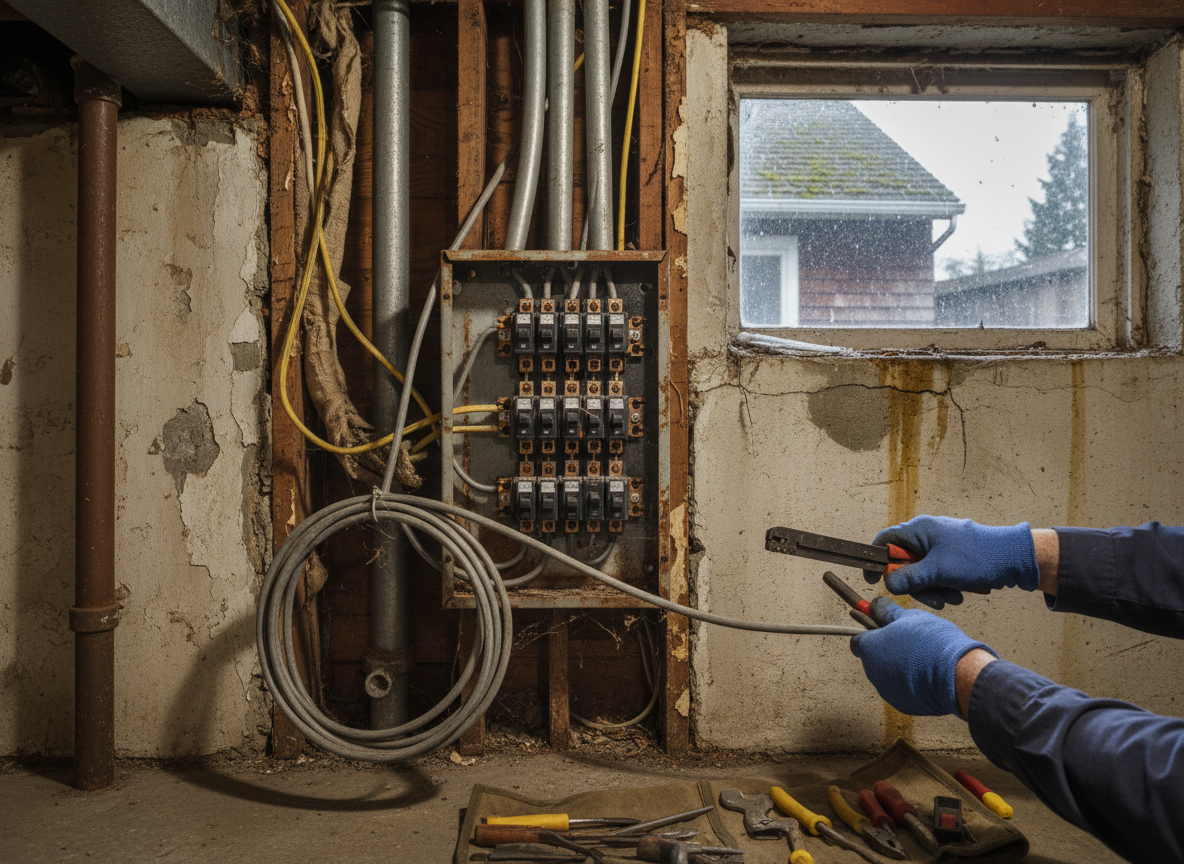
Single strand aluminum branch wiring, installed widely from about 1965 to 1973 when copper prices spiked, fails at its terminations: connections at outlets, switches and splices loosen and oxidize over time, overheat, and can start fires. The wire itself carries current fine. The approved fixes are COPALUM crimps, AlumiConn connectors, or replacement, not ordinary pigtails with standard wire nuts.
The Mechanism: Why Aluminum Fails Where Copper Does Not
Three properties of aluminum conspire at every screw terminal:
- Oxidation. Aluminum instantly forms an oxide skin on exposure to air, and unlike copper oxide, aluminum oxide is a poor conductor. Any gap or loosening at a termination grows an insulating layer that forces current through a smaller and smaller contact area.
- Thermal expansion. Aluminum expands and contracts more than copper as it heats and cools with load. Every kettle boiled and space heater run cycles the connection, and the cycling gradually works the wire loose under the screw.
- Creep. Under the constant pressure of a terminal screw, aluminum slowly deforms and flows away from the pressure point. The connection a builder torqued tight in 1968 has been relaxing for almost 60 years.
Loosening, oxide growth and heating feed each other. The connection runs hotter, the heat accelerates creep and oxidation, and the end state is a charred receptacle or a melted wire nut inside a wall box. This is why the failure statistics for aluminum-wired homes concentrate at devices and splices, and why the wire in the middle of a run is essentially never the problem.
The era matters. Pre 1972 aluminum wire used an alloy with poor creep resistance, and devices of that era were designed for copper. Wire made after the alloy change, and devices rated CO/ALR, perform better together, but the vast majority of what is in Portland walls from this period is the original combination. You find it in the mid century neighborhoods and 1960s and 1970s construction across the city, and frequently in additions of that era grafted onto older houses, so a 1920s bungalow can have knob and tube upstairs and aluminum in the 1971 family room, 2 different remediation problems under 1 roof. These same houses often carry Federal Pacific Stab-Lok or Zinsco panels from the same years, and the combination of breakers with a documented failure-to-trip history protecting terminations prone to overheating deserves priority attention.
To be clear about scope: this concerns 15 and 20 amp branch circuits in single strand aluminum. Larger stranded aluminum feeders and service entrance conductors, used for ranges, subpanels and services, remain standard practice today when terminated correctly, and are not the hazard this article covers.
How to Identify Aluminum Branch Wiring
Look in 3 places:
- The panel. With the cover off, a job for a licensed electrician, aluminum branch conductors are silver colored where they land on the breakers and neutral bar, and the insulation is often marked AL or ALUMINUM along its length.
- Visible cable runs. In the basement, garage or attic, read the jacket printing on the NM cable: the word ALUMINUM or the marking AL appears on the sheathing of aluminum romex from this era.
- The house's vintage. Wiring installed between roughly 1965 and 1973 is the window. A 1968 ranch or a 1971 addition should be checked as a matter of course.
Symptoms of failing terminations: warm cover plates on switches or receptacles, flickering lights on a specific circuit, a hot plastic smell with no obvious source, crackling at a device, or receptacles that have stopped working entirely, which often means a connection has burned open upstream in the circuit. A subtle field sign we check for: intermittent circuits that come back when someone wiggles a plug, because the wiggle temporarily remakes a failing aluminum joint at the backside of the device.
One caution on past repairs. Many aluminum houses have been "fixed" over the years with ordinary copper pigtails under standard wire nuts, or with devices swapped for standard copper-rated ones. Standard pigtailing with a plain wire nut is not an approved repair for aluminum: it just moves the aluminum-to-connector problem into the box with an unrated connector. Previous remodels are also where problems hide: a 1990s kitchen update that backstabbed or terminated aluminum on copper-only devices is worse than the untouched original wiring.
What to Do About It and When It Becomes a Safety Issue
The recognized permanent repair short of rewiring is fixing every termination, at every outlet, switch, fixture and junction box, with a connector rated for the job:
- COPALUM crimps: a special tool cold-welds a copper pigtail onto each aluminum conductor, with an installed sleeve. Considered the standard permanent repair, but it requires a contractor with the proprietary tooling, which limits availability.
- AlumiConn connectors: a small lug-style block with individual setscrews, torqued to specification, joining aluminum to a copper pigtail. Widely available, accepted as a sound repair when installed correctly, and the practical choice for most Portland projects.
- CO/ALR devices: switches and receptacles rated for direct aluminum termination. Acceptable for device connections, but they do not address splices, fixtures or the connections inside junction boxes, so they are a partial measure, not a whole-house fix.
The complete alternative is rewiring the affected circuits in copper, which makes the most sense when walls are already open for a remodel, when the panel needs replacement anyway, or when a load calculation for a heat pump or EV charger shows the house needs new capacity regardless. Circuit-level work of this kind takes a permit through Portland Permitting and Development and inspection under the Oregon Electrical Specialty Code, and a remediation visit should also correct related-era defects like missing GFCI protection and ungrounded fixture boxes while each box is open. Our aluminum wiring repair and remediation work covers both paths, from termination-by-termination repair to full copper replacement.
Untouched aluminum wiring with no symptoms is a schedule-it problem: plan a full termination remediation deliberately. It becomes a safety issue now when heat announces itself: warm plates, burning smells, buzzing, flickering tied to one circuit, or any charring found at a device. Kill that circuit at the breaker and have it opened up promptly. And if you are buying a 1960s or 1970s house, price the remediation before closing, because insurers increasingly ask about aluminum wiring and some require proof of repair.
If you suspect aluminum in your house, we can map which circuits carry it and quote a full termination repair or a rewire, whichever the house actually needs.
Frequently Asked Questions
Is aluminum wiring in my house something I have to remove?
No, full removal is not required, and complete rewiring is only one option. The recognized repairs, COPALUM crimped pigtails or AlumiConn connectors at every termination, plus CO/ALR rated devices where appropriate, address the failure points and leave the wire in service. Rewiring in copper makes better sense when a remodel opens walls anyway or the panel and service need replacement too. Doing nothing indefinitely is the one poor choice.
How do I know if my 1960s house has aluminum branch wiring?
Check the printing on visible cable jackets in the basement, garage or attic for ALUMINUM or AL markings, and note the construction date: roughly 1965 to 1973 is the window. Silver colored conductors at the panel confirm it, but leave the panel cover to a licensed electrician. A house from this era should be checked even without symptoms, because failing terminations hide behind cover plates and give little warning before they overheat.
Can I just put copper pigtails on aluminum wires with regular wire nuts?
No. Standard wire nuts are not rated for aluminum-to-copper connections, and this common shortcut recreates the original problem inside the box: dissimilar metals, oxidation and thermal cycling at an unrated connector. Approved methods are the COPALUM crimp system, installed with proprietary tooling, or AlumiConn setscrew connectors torqued to spec. The material cost difference is small compared to the cost of a burned splice buried in a wall.